---
title: "Business Thinking for Designers"
author: "by Ryan Rumsey, Founder of CDO School"
url: "https://books.thecdo.school/2/business-thinking-for-designers"
---
Options to read the book
Thank you for reading the book! I have two options for you: a digital edition and a pdf download. If you have any trouble accessing either, please let me know. :)
_Bookmark this url for the Digital version_
Download the PDF version
Business Thinking for Designers
Business Thinking for Designers is the guide to increasing your impact and value at work by learning how design connects to the bottom line. Discover the essential vocabulary and strategies to effectively communicate with your business partners, plus tools, tips, and frameworks that you can put right to work.
This book will equip you with the knowledge and know-how to transform your career and company by bringing a business mind to design. Written by Ryan Rumsey, founder of [Chief Design Officer School](https://thecdo.school), and veteran of Apple, Electronic Arts, Nestlé, and USAA.
As of October 2025, Business Thinking for Designers has been read by over 60k designers around the world.
Copyright © Second Wave Dive, 2020
About the author
Ryan Rumsey is the CEO of [Second Wave Dive](https://www.secondwavedive.com), a creative studio meets HoldCo where he builds profitable, bootstrapped businesses… then find aspiring entrepreneurs to run them. Ryan is also the founder of [Chief Design Officer School](https://www.thecdo.school) and [Jump Ship](https://www.letsjumpship.com).
Ryan is the trusted partner to many of the worlds leading designers and teams. Whether as the executive coach to Directors, VPs, and CDOs, or working with companies like Google, Zillow, Uber, and ANZ, his programming and insights have helped over 3000 designers around the work accelerate their careers and impact.
Ryan has a hybrid background in interaction design, front-end development, and product management. Previously he led digital product innovation and transformation at Apple, Electronic Arts, USAA, and Nestlé. His life experiences include working on a farm and acting in a Staind music video. Ryan is a dad, partner, and massive fan of the Liverpool Football Club.
Acknowledgements
Thank you to everyone who contributed to the written version of _Business Thinking for Designers_
**Editors:** Aarron Walter, Bart King, Rob Goodman, Jessica Dawson
**Illustration:** Ranganath Krishnamani
**Creative Direction:** Aaron Stump
**These people were instrumental in the writing of this book:** Sally Rumsey, Nguvet Vuong, Sarah Mills, Susan Price, Chris Wilkinson, Keith Aric Hall, Lucas Coelho, Greg Storey
Contents
Chapter 1
[Why you need to know business
](https://books.thecdo.school/2/business-thinking-for-designers/34/chapter-1-why-you-need-to-know-business)
Understand the business impact of design
Chapter 2
[Explore business concepts
](https://books.thecdo.school/2/business-thinking-for-designers/27/chapter-2-explore-business-concepts)
Essential vocabulary, models, and strategies
Chapter 3
[Develop your business perspective
](https://books.thecdo.school/2/business-thinking-for-designers/30/chapter-3-develop-your-business-perspective)
Your business partners and you
Chapter 4
[Create conditions for design maturity
](https://books.thecdo.school/2/business-thinking-for-designers/37/chapter-4-create-conditions-for-design-maturity)
Gain perspective of how design connects to business
Chapter 5
[Communicate the options
](https://books.thecdo.school/2/business-thinking-for-designers/39/chapter-5-communicate-the-options)
How effective communication helps business partners understand design
Chapter 6
[Put it all together
](https://books.thecdo.school/2/business-thinking-for-designers/41/chapter-6-put-it-all-together)
Ways to incorporate these lessons inside your organization
Appendix I
[Bonus Articles
](https://books.thecdo.school/2/business-thinking-for-designers/44/2025-bonus-articles)
Additional resources to become a business savvy and street smart designer
Appendix II
[Bite-Sized Videos
](https://books.thecdo.school/2/business-thinking-for-designers/47/bite-sized-videos)
Quick, pragmatic lessons to see business stuff in new ways
Appendix III
[Book Reviews
](https://books.thecdo.school/2/business-thinking-for-designers/46/book-reviews)
A handful of the reviews and messages I've received over the years

Chapter 1
Why you need to know business
Understand the business impact of design
Within a week of starting what I thought was a dream job, I was overwhelmed. At three months, I was really struggling. After six months, I doubted my abilities to fill the role.
What had worked as a design leader at Apple was not working at Electronic Arts (EA).
In the spring of 2011, I accepted an opportunity to shape a new organization called Worldwide Customer Experience (WWCE) at EA. After years of paltry customer-satisfaction ratings, EA tasked WWCE with supporting a transition to a “player-first” organization. In my role as senior manager of customer programs, I was responsible for leading a team of UX designers, program managers, and front-end developers.
I was highly motivated for the challenge and expected to excel from day one. But it didn’t happen.
While quitting and finding another gig was an option, it didn’t feel right. I had taken a big personal risk in leaving Apple to join EA. I told my family it was a risk worth taking, and I felt it was my responsibility to make it work.
Choosing to stick it out ended up being the best professional decision I’ve ever made. By being uncomfortable, yet committed, I opened myself up to learning a new way to succeed. I had to adapt to survive and that meant developing skills in an area I had previously trusted others to handle: business.
Over the last 10 years, I’ve been able to expand and refine these skills while leading design and strategy at companies like EA, Nestlé, and USAA. What I’ve learned is if you understand the basics of the business model and strategies in which you’re working, you’ll be able to spend less time explaining the value of design and more time actually designing. It will also increase your credibility. Developing this understanding may be easier than you think.
In an effort to share best practices with others, I started [CDO School](https://www.thecdo.school) and packaged six years of courses, lessons, and insights inside [The CDO School Toolkit](https://www.thecdo.school/toolkit/). I work alongside teams large and small to help mature design in their organizations. In this book, I'll pass along some of what I learned and what I teach, but first let’s talk about why designers benefit from fostering business skills.
Design is in demand
Design is definitely having a moment. It’s being driven by the popularity of Design Thinking, Design Sprints, and Stanford’s d.School, as well as the business value created by design for companies like Apple, Airbnb, IBM, Ford, Nike, Whirlpool, IKEA, and others. Business leaders now make significant investments to incorporate design to gain a competitive edge.
From startups to multi-national juggernauts, titles like Chief Design Officer, Head of Design, and VP of Customer Experience are now common. Sketching is no longer just an activity for “creatives.” Post-its and Sharpies are tools of the trade across functions, and business leaders across industries develop their organization’s design potential.
In short, we’ve made it. Our favorite Venn diagram worked!
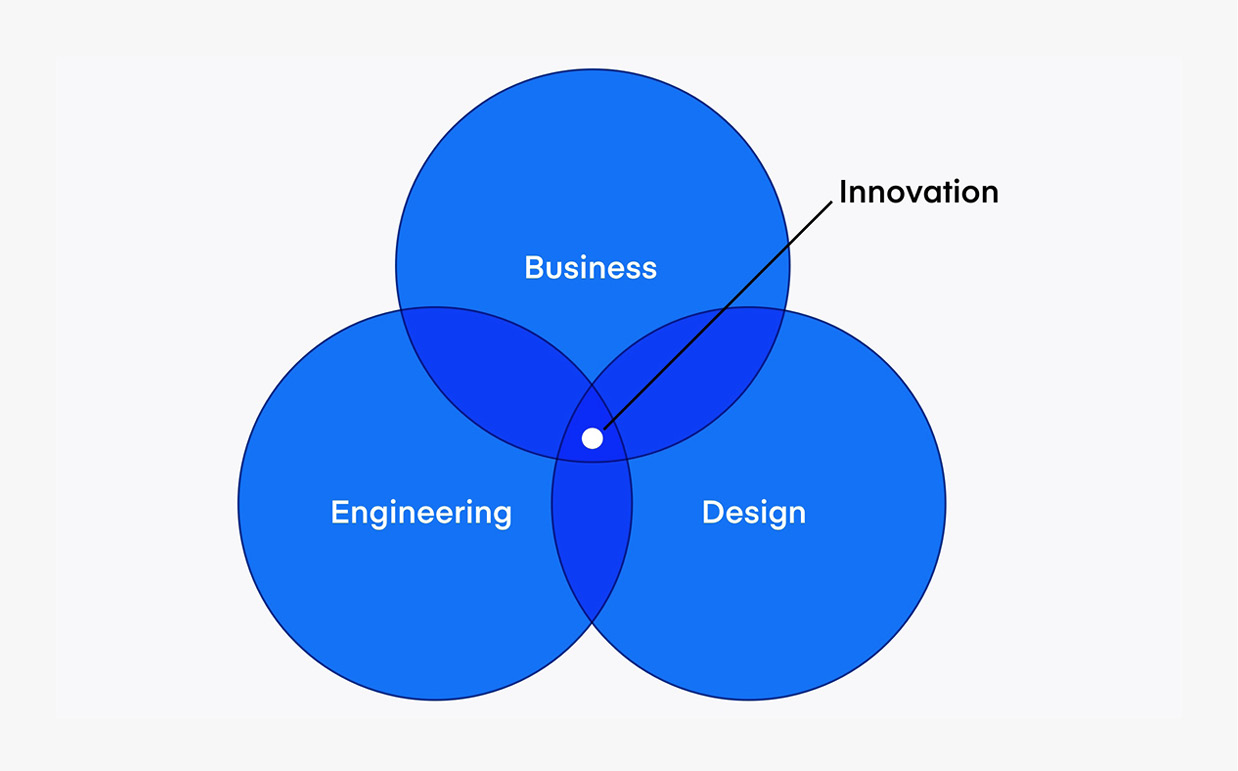
Figure 1-1: The Venn diagram of innovation
So you may be asking: Why should designers do anything different?
‘Making it’ is different than we expected
When lists of the top innovation companies are published, a lot of familiar faces show up. From Airbnb to Netflix to Nike, these organizations invest heavily in design to gain a competitive advantage. While many popular narratives describe how these companies turn to design, what’s equally important (and less-discussed) is how design leaders at these companies look to business to drive value.
For many design leaders, “making it” involved years of painful business lessons. And there are many more designers out there today who still struggle to learn these lessons on their own. There has to be a better way forward. Here’s my assertion:
- Designers with the most success in our industry are business-aware.
- The world needs more successful designers involved in strategic decisions, therefore more designers need to learn the language of business.
- Applying known methodologies and tactics provides designers with practical steps to develop business acumen faster.
Ethics matter
_“Are we enabling others to do harm?” _
_“What do we capture from customers in exchange for money?” _
_“If customers aren’t paying, how do we make money?”_
Be it privacy, security, or politics, many companies face backlash and/or gain a competitive advantage because they align their ethical positions to those of their customers. (Recent surveys confirm ethics has become an important purchasing factor.)
This trend is so significant that the Business Roundtable, the most influential group of corporate leaders in the U.S., recently changed their mission statement for the first time since 1997. Rather than addressing only shareholder value, the new mission statement speaks to valuing customers, employees, suppliers, communities, and shareholders. Even if this move is merely symbolic, leading organizations now realize ethical perceptions matter a lot.
With customers using their purchasing power to support purpose-driven companies, organizations around the globe are aligning corporate values to customer values. As designers gain business acumen, we can influence the ability of our organizations to understand and live up to these values. Also, as employees, we grow more capable of finding companies whose values align with our own.
Organizations need a competitive advantage
Staying one step ahead of competitors usually results in success. To do so, companies investigate different ways to create an advantage. Designers may not always realize it, but our methodologies are uniquely able to help with this.
Take for instance ground transportation. There are public options like the bus and train. There are ride-share alternatives like Lyft and Uber. And there are expensive premium services like limousines and town cars. When companies enter a crowded market with a new product or service, they make strategic decisions to differentiate themselves as the obvious choice for at least one type of consumer.
While factors like pricing or availability are important to some consumers, others may be more concerned with ease of payments, scheduling, ratings, or support. As competition in a market increases, designers who understand business are uniquely qualified to highlight how these factors play out in real-world scenarios.
Becoming a leader requires spending less time on craft
Many designers aspire to lead other designers, teams, practices, and organizations.
There are wonderful resources to help new design leaders learn how to manage others, provide opportunity and visibility to designers, and lead junior talent in seeing the forest and the trees. The further designers progress down this path though, the less design craft will play in day-to-day responsibilities. Craft becomes the responsibility of others on the team.
> If you just go into the room and narrowly think about “design, design, design,” and if you don’t value the business or understand why you have to move to market quickly, your contribution will not be felt.  - Kate Aronowitz, Design Partner at GV
As designers move into leadership roles, they are increasingly responsible for decisions that impact both customer value and the company’s bottom line. This includes managing budgets, allocating resources, hiring/firing, and calculating return on investment (ROI). These responsibilities are building blocks of business, regardless of industry. And while design leaders may not have to crunch numbers every day, they need the skills in order to competently participate in discussing expenses, operational planning, strategy, and the other day-to-day concerns of company leaders.
Ultimately, design leadership is about building better companies and team culture. Those who do it well stretch themselves beyond just design.
We’re the new kids on the block
I’ll be blunt. Designers need to learn business because we can’t expect our counterparts to listen just because we’ve arrived. We need to meet them where they are. That means learning what other functions do, why it’s important, and being able to bridge the communities of business, design, engineering, and product.
Driven by digitization, companies around the globe have created products and services over the last 25 years at an unprecedented scale. They’ve needed engineers and developers to turn big ambitions into practical realities. And now that competition is fierce, business leaders turn to designers to find new ways to create value.
While the power of design is making products and services better, it’s important to remember that we’re joining an ongoing conversation. And the truth is: they could build things without us.
It’s 2020 and design is a key differentiating function for many companies, but it’s still an optional function. To deal with existing cultural norms in a business—and shape new ones—designers must show how they provide value to those functions that have been there all along.
Pro tip
Paul Adams gave a direct, and perhaps hard-to-take, view of designers called The End of Navel Gazing at UX London in 2018. It’s a serving of humble pie, but it highlights that we’re not victims of the business environment. That was a lesson I had to learn at EA. Becoming business-aware gave me the ability to contribute to more diverse meetings. By learning the language of business, I was empowered to step out of the victim mindset.
The opportunities ahead
The opportunities designers have in today’s marketplace are robust. Traditional, for-profit companies are transitioning from purely financial priorities to customer-first. Non-profit or government organizations are transitioning from economic models to community- and citizen-led. And designers are being asked to participate in these transformations, large and small.
Business-aware designers have the ability to influence outcomes in ways no other function can. We have the power to impact the professional and personal worlds we want to live in. The next step for designers is to go beyond having a seat at the table, to being a leader at the table. With our influence, we can build healthier societies through healthier businesses. But we must know business to begin.
How to use this book
Business models, financial portfolios, and industry regulations are not typically the focus of a designer’s work. Yet each of these can be impacted by design.
The tools and frameworks in this book are meant to help you evaluate fundamental business concepts. This will put you in a better position to influence strategic decisions beyond the typical purview of design. Throughout the book, I’ll share advice from my experiences leading design, product, strategy, and development teams and organizations. I’ll also share insights from my peers and offer practical tips you can try for yourself.
I’ve divided the book into thematic sections:
- Business basics you should know
- Develop a business perspective
- Transcribe design value
- Communicate trade-off options
- Put it all together
Given that no business or organization is the same, there’s no linear, step-by-step learning process that applies to all situations. Therefore, the book is not meant to be followed like a process or guide. Instead, each section serves as a reference to which you can return as needed to tune your business skills in parallel with the real-world scenarios you face.
Whether working as an in-house designer or at an agency, for a large organization or a startup, the lessons in this book will be relevant. Feel free to skip around to find the content that’s most applicable in the moment. But try to keep the following mindsets as you build your business expertise.
Approach it like a new language
In 2013, my family and I moved to Lausanne, Switzerland, where French is the primary language. While my wife and I had some understanding of French, we quickly realized it would not get us very far in our day-to-day interactions. We had to find a way to learn quickly.
After a recommendation from friends, we began The Michel Thomas Method. A core principle of the method is to remove anxiety from the learning process and boost the confidence of students early and often. While we didn’t become fluent overnight, within a few weeks we were able to have many of the basic conversations we needed, with little stress.
Developing business acumen can be a similar process. Accepting that business is an unfamiliar language, we can take small steps to join conversations and develop confidence through familiar methods. Over time, we’ll begin to understand the different dialects used by different organizations within the business.
Did you know?
Twenty years ago, few business leaders understood design. Agencies like IDEO, Frog, Adaptive Path, and Cooper began teaching Design Thinking to business leaders as a framework for innovation. In large part, it’s been so successful because it reduced the stress and anxiety of learning a new approach to problem solving. As a result, business leaders simultaneously learned the language of design and bought into its value.
Recognize patterns to anticipate
At the beginning of Michel Thomas’s instructional audiobooks, he demonstrated that I already knew more French than I realized. Many English words ending in -able, -tion, -ical, and -ary have the same meaning—and similar pronunciation—in French. In giving these examples, Thomas provided basic patterns to build on.
As a designer, I’m confident in my work when I can anticipate what users do, and I have methods and tools to familiarize myself with patterns of user behavior. But when business leaders first began inviting me to meetings, I couldn’t anticipate what they would do. As a result, I was intimidated by the people in the room and their conversations. I assumed it was all very important, complex stuff, and my confidence was shot.
I was fortunate though. I had a wonderful mentor at the time, Jeff Bradburn. During one of our daily walks, he reminded me that I researched humans every day and that the people in those meetings were “just humans.” It was at that moment that Jeff demonstrated that I knew more than I realized. I had the methods and tools to familiarize myself with patterns of behavior. I just needed to apply that knowledge to learning business.
Now I know, most business meetings are quite ordinary. The more I witnessed status updates, task delegations, and pats on the back, the more I recognized behavioral patterns and could anticipate what people in the room would do. Learning business is as much about anticipating needs and behaviors as it is learning terms and concepts.
Similar patterns of behavior exist inside most organizations and industries, and the questions business leaders ask of design leaders and their teams are remarkably the same. In the sections that follow, I’ll point out basic patterns to help you anticipate what happens next and prepare for meetings with business leaders.
Rely on your design skills
Design, at its core, is applying an intentional approach to problem solving. As you apply processes to different problems, you broaden your relevant knowledge and vocabulary. The same can be true of learning the language of business.
For example, while still at Apple, I applied design methodologies to a business management problem while prototyping several digital applications. The end result went beyond expectations and ended up having a positive impact on employee retention. My point is, we can still do what we're good at—design methodology—but apply it to all the needs of the business, not just the customer or user experience. Doing so helps us better communicate and partner with other teams, understand the broader effects of our work, and progress in our individual careers.
Methodologies like Design Thinking, Double Diamond, Lean UX, or Human-Centered Design do more than create an interface. By applying those powerful tools to solving business problems, you will level up your business knowledge and impact.
Identify the intersections
Have you ever seen those crazy storm chasers who try to get as close to a tornado as possible? They speed around in vans and trucks with one eye on the clouds and another on the radar. Their goal is to know where the big cell is, which direction it’s heading, and when it’s expected to get there so they can find the right moment to meet it. The same is true for designers who want to get close to the action.
Every project or product you work on will have a variety of elements that influence how well the project will go. Timelines, values, goals, personalities, etc. are all factors to consider in finding the right moments to converge with your colleagues.
To level-up your business impact, it’s critical to know where business partners are, where they’re headed, and the factors shaping their viewpoints. Throughout this book, I’ll teach you how to know where your business is and where it’s going so you can be at the right place at the right time. Some of the exercises will be introspective in nature and may be challenging. But they’re well worth the time.

Figure 1-2: Identifying intersections to meet out business partners
Three steps to anticipate the intersection:
- Step 1: Identify the direction, velocity, and intensity of your business partners Analyze where they’re coming from, what they’re looking for, what their priorities are, what expectations they have, and what they get when they arrive.
- Step 2: Discern the direction, velocity, and intensity of design Are you considering the same factors as your colleagues? Are you working from shared values? Do you have the same priorities? Are your expectations the same? Analyze where you’re coming from so you can both head in the right direction.
- Step 3: Project the potential intersections Identify places to meet up along their journey. Suggest options of new destinations after you connect. Provide them with accountability to stay aligned in the new direction.
Use the scripts
Meeting the expectations of business leaders is a learned skill. While we all have different ways of learning, a handy script can often quicken the process.
In this book, I provide scripts to limit your frustration and keep you moving in a productive direction. Scripts are useful reminders that you typically don’t need to reinvent the wheel. Designers deal with similar business scenarios and behavior patterns across industries. The scripts—along with other tools and frameworks—should accelerate your progress.
The step-by-step scripts are provided for real-world scenarios. Examples of those scenarios include:
- Getting buy-in from business partners
- Calculating the ROI (return on investment) of design
- Connecting design objectives to business objectives
- Negotiating with non-designers
- Communicating trade-off decision risks and benefits
Conclusion
Now that you know how this book is intended for use, you’re ready to dive in. Just keep in mind that learning any new language takes time and patience. But with design methodologies in your tool belt, you’re better equipped than most to investigate and recognize patterns. And soon, you’ll understand how intention can directly and indirectly shape decision-making in your company.
Further reading
- The Design Leadership Playbook
- The Michel Thomas Method
- Design Thinking at IDEO
- Design Council's Double Diamond
- What is Lean UX? By Jonathan Follett, Principal of Involution Studios
- What is Human-Centered Design? by IDEO

Chapter 2
Explore business concepts
Essential vocabulary, models, and strategies
About six months after joining Apple, I moved from a team focused on internal training to one responsible for customer-support programs. When I joined the new team, I struggled to convince my peers in Program Management that dedicated time for research was an important part of the design process.
As I reflect on that experience, I realize I simply lacked the language to get others on board with my ideas. I was speaking design, but my colleagues were speaking business. I didn’t take the time to get to know their unique needs and objectives before I made suggestions on how I could improve things. To help you avoid my mistakes, here are some essential concepts you can introduce to your vocabulary to help you align better with your colleagues.
As with learning any language, vocabulary is important. Here, we’ll review the terms and concepts you’ll need to communicate effectively with leaders across the business. Chances are, you already have a loose understanding of what these mean. But let’s nail them down.
- Competitive advantage – A condition or circumstance that puts an organization in a superior business position relative to competitors. For example, Apple uses design as a competitive advantage. Geico uses low prices.
- Profit – The difference between the cost of making or buying something, and the price at which it’s sold.
- Profit margin – The amount of profit a company keeps relative to the sale price. Typically referred to as high or low, companies use profit margin to determine whether they need to sell a lot or a little of something to achieve income targets. Apple earns high profit margins on their iPhones, so they don’t have to sell a lot of them to make money. The fact that they do sell a lot is a major reason why they have over $200 billion in cash. Geico has low profit margins on their policies. So they have to sell a lot of policies to make a meaningful amount of profit.
- Trade-offs – Decisions companies make to reduce something in return for increasing something else. A common trade-off is the good-fast-cheap scenario, in which you can only have two of the three characteristics. For example, you must choose between quality (good) and speed (fast).
- Supply and demand – The inverse relationship between the quantity of products or services a market can provide and the desire for them. Companies can affect demand by controlling supply. For example, diamonds, believe it or not, are not rare. They’ve been made rare in the marketplace by supplying less than what is available. This has helped create increased demand over the last 80 years.
- Market forces – Pressures that change the supply and demand of products in a free market. These include the threat of new competitors or substitute products, the bargaining power of customers or suppliers, and the amount of competition a company faces.
That wasn’t so difficult, right? Most of us already know more about business than we may think. Now let’s take it up a level.
Business models
A **business model** is an outline of how a company intends to create and capture value. It describes what will be valuable to customers, how that value will be produced and delivered, and why it will generate revenue for the company. This outline is not only a foundation upon which business decisions are made, it’s also an effective description of the values designers are expected to help provide, so it’s important to understand the model you’re working in.
Selling products online—a.k.a. **e-commerce**—is a popular model in the digital world. They typically fall into one of three categories with matching acronyms. B2C businesses sell directly “2” Consumers. B2B indicates selling to other Businesses. And B2G is when you sell to Governments. In recent years, there’s also been the addition of C2C, in which consumers sell to one another via platforms like eBay or Indiegogo.
Within these e-commerce categories, business models vary significantly, as entrepreneurs have adapted successful offline models to work online. Examples include:
- Freemium – Giving a product or service away for free, then charging later when customers need additional features or services to get the most use out of the product. Examples include Mailchimp, Slack, or Skype.
- Marketplace – A platform where a fee or percentage of a sale is taken in without managing the inventory being exchanged in the sale. Airbnb and Etsy are e-commerce marketplaces that could be compared to a farmer’s market or flea market in the physical world.
- Subscription – In exchange for a regular fee, customers have ongoing access to a product or service. Think Netflix, Spotify, Orangetheory, or your local paper.
- Disintermediation (a.k.a. cutting out the middleman) – Selling directly to customers by forgoing retail partners. This allows a manufacturer to lower costs and own the full relationship with the customer. Successful examples include Casper, Warby Parker, and Dell.
- Franchises – A company licenses the use of its business model, brand, and the rights to sell its products or services. McDonald’s, Allstate, and H&R Block are all franchises.
- Low Touch – Selling products and services with minimal interaction between the company and the customer. IKEA and EasyJet do this. So does SurveyMonkey.
- Razor Blade – A low profit-margin product that requires high-cost or high-regularity companion products. Disposable razor blades, ink-jet printers, and the Amazon Kindle all use this model.
- Reverse Razor Blade – A high profit-margin product that comes with low-cost companions products. The Apple iPhone is an example that enables access to loads of low-cost music, movies, and TV.
- Advertising – Rather than selling directly to consumers, businesses sell access to an audience to promote or sell products, services, or ideas. This is what Google does, as well as network television and radio.
As you might imagine, some companies have multiple business models at the same time. Apple is incorporating reverse razor blade, e-commerce, and subscription models across their portfolio, all at once.
Business strategies
While a business model describes how an organization creates and captures value, **business strategies** are how an organization aims to do those things better than competitors. There are typically several viable business models within a market, which means it’s ultimately the strategies that will lead to success or failure.
To gain a competitive advantage, there are three generic strategies companies use:
- Become a cost leader
- Create differentiation
- Target a niche customer base
These generic strategies were popularized by Michael Porter in his 1985 book, Competitive Advantage: Creating and Sustaining Superior Performance.
Let's look at how two companies in the same industry use similar models, but have vastly different strategies to gain a competitive advantage. Dell and Apple both use the disintermediation model to provide direct-to-consumer computer products. Dell chose the cost-leadership strategy, providing affordable, customized computers quickly through a well-oiled supply chain.
In the same market, Apple uses differentiation by focusing on premium, easy-to-use products with high-quality purchasing experiences, world-class design, and integrated products and services.
While the strategies for Dell and Apple are fundamentally different, both companies arrive at their strategies by answering two basic questions:
- Where does the company play? – Which customers, territories, and channels (e.g., box stores, online, phone, etc.) will the company target?
- How does the company win? – What will the company do to create a competitive advantage for itself?
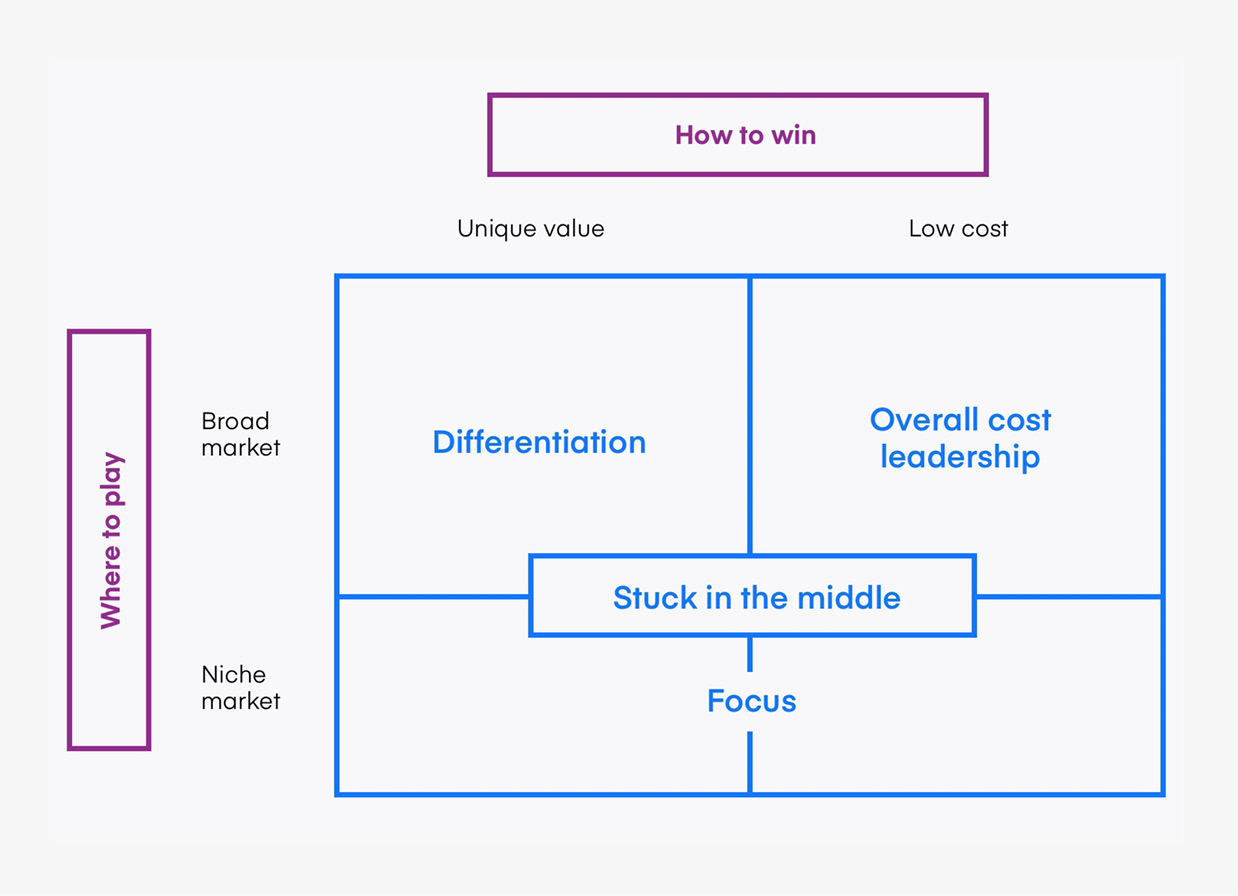
Figure 2-1: Porter’s Generic Strategies
When Dell and Apple determined their respective strategies, they chose different types of customers, channels, and methods to win their share of the market. The answers to these two strategic questions also inform whether a company or product is focused on growth or profit.
- Growth focus: When a business aims to gain market share or diversify the products or services it offers, sometimes at the expense of short-term profits.
- Profit focus: When a business aims to maintain profits over reinvesting in the production of new products.
The job of those “at the table” is to know how to make decisions that support the strategic focus. Are you pushing to create new products at a time when your company is focused on profits? If so, you’re out of step with the organization. Are you showing how accessibility improvements can help gain market share for your startup? If so, you’ll likely have an easier time gaining support. Take a few minutes now to consider whether or not your approach to design is in line with your company’s current business focus.
In Chapter 3, we’ll review several ways to quickly determine where your company plays, what and how the company aims to win, and the strategic focus they pursue.
Pro tip
As a designer, the strategy your company chooses to gain a competitive advantage is important to your work. Of equal importance is whether your company is focused on growth or profit. Generally speaking, startups are focused on growth in hopes of finding revenue models later, while established companies tend to be focused on profit while keeping an eye out for new growth opportunities.
Perspectives of company health
To understand what strategies work, business leaders create a variety of objectives, measures, and targets for products and teams. To evaluate the overall health of a company, these objectives, measures, and targets are set across multiple perspectives, with each one focusing on a different aspect of the company.
While these aspects can vary from company to company, many approach overall health using four basic perspectives:
- Financial – This is the traditional and cumulative view of company success. It looks at the monetary results of past decisions.
- Customer – This perspective focuses on the people who buy a company’s products and the value provided to them.
- Operational – Efficiency is the focus of this perspective, as well as how smoothly processes and teams are running.
- Learning & growth – This perspective is all about employees. What are the key skills to be developed, the core processes needed to create products and services, and the cultural environment necessary for success?
Companies with long-term, viable business models prioritize these perspectives effectively to create value for internal and external stakeholders. In doing so, they also define their company cultures.
As designers become more aware of how objectives, measures, and targets relate to the prioritization of these perspectives, we can better evaluate the impacts of our solutions on the business. We are also better equipped to evaluate the culture of the organization itself.
In Chapter 4, we’ll dive deeper into these perspectives and how they are prioritized and measured.
Value-based decision making
Businesses survive when they create value for customers. Businesses thrive when they create more value for customers than their competitors.
There’s an idea inside many organizations that in order to create business value and make business decisions, you have to go to business school. But the reality is, not all value is created by the techniques taught in business school.
Here’s an example you likely won’t find in business school curriculum: Did you know that for the health of a child with a fever, parents have to keep track of which medication was used last? This simple task can create undue stress for parents during a time when stress levels are already high. There would be tremendous emotional value in relieving this stress.
While financial concerns often inform business decisions, subjective factors should also play an important role in decision-making. Intangible aspects like ethics, morals, or emotions need to influence decisions on everything from project roadmaps to branding. Designers are uniquely qualified to advocate for these values.
To distinguish the effects of these different types of values, let’s define them as “actual” or “perceived.”
- Actual value – When math is used, actual values are in play. These are the numbers used to calculate the costs to make something, the prices at which products are purchased, the salaries of employees, the hours needed to develop a tool, etc. When EA decided to invest in new software for customer support agents in 2011, the costs of licensing and maintaining that software came into play. While actual values are relatively simple to calculate, not all companies make trade-off decisions using math.
- Perceived value – While difficult to calculate, perceived values have equal, if not more, importance than actual values. When customers or executives use terms like excellence, simple to use, or beautiful, these are all examples of perceived values. These values are less sticky and require a lot of clarification to understand. I’ve worked with plenty of stakeholders over the years who wanted to “just design it like Apple does” because they think it’s the most beautiful.
Combined, these two categories reflect how customers and businesses expect to receive total value from products or services. Historically, designers focused primarily on perceived value. However, our business partners need us to focus on actual value as well.
My friend Kara DeFrias shared an example of combined focus on the _Hacking the Red Circle_ podcast. While at Intuit, she pitched an internal TEDx event for employees. Though she was focused on providing a world-class experience, to secure the necessary funding from her leadership team, she connected the event to the core values of the company and created a worksheet to track each minute of the event to keep costs under control. This approach worked and in turn, created a one-of-a-kind event for the company called TEDxIntuit.

Kara DeFrias
Including a quantifiable discipline can help us better anticipate the outcomes of our work on perceived values. This is important because every company has different levels of maturity for measuring value. Poor measurement means well-intentioned people can make decisions that negatively impact the business. An important aspect of our job is to increase the maturity around us and that starts by having a stronger aptitude for measuring value. I’ll cover this more in Chapter 4, but know that when we measure our work, customers, employees, partners, and other stakeholders can better understand the benefits of the design approach.
The job of those “at the table” is to know how to create enough value for customers and actual value for the business to survive or thrive—and to make decisions that satisfy both. When the conversation at the table changes to actual value, designers often don’t have much to say. It separates us from other functions. But we can fix that.
Conclusion
My attitudes about design changed as I began to understand basic business concepts. I knew how design impacted the lives of customers, but I suddenly began to see how it affects the ability of business partners to make decisions as well. I realized that addressing only one perspective of value made it more difficult to gain consensus on my recommendations.
By learning basic models and strategies, designers can incorporate the language of business into their analysis and recommendations. Then, by communicating the actual and perceived value design brings to the business, you’ll find more support for your work and ideas.
Further reading
- The essential components of Business Models and Business Strategy for design leaders
- Porter’s Generic Strategies by the Mind Tools Content Team
- Competitive Advantage: Creating and Sustaining Superior Performance by Michael Porter, a C. Roland Christensen
Professor of Business Administration at the Harvard Business School
- Porter’s Five Forces by the Mind Tools Content Team
- 7 Things Every Designer Should Know About Business by d.mba

Chapter 3
Develop your business perspective
Your business partners and you
Now that we’ve reviewed basic business fundamentals, this chapter will cover practical steps to get to know your business and business partners.
It’s fundamental to your design work to understand the models and strategies specific to your business and the people who use them. With your creative problem-solving processes you can:
- Visualize your business
- Anticipate the needs of your partners
- Analyze the effects of culture on decision-making
- Reflect on how you are or aren’t having an impactVisualize your business model and strategy
Visualize your business model and strategy
To get a high-level idea of where your company plays and how it wins, there are two diagrams you can use: The Business Model Innovation Framework and the EcoSystem Map.
To get a high-level idea of where your company plays and how it wins, there are two diagrams you can use: The Business Model Innovation Framework and the EcoSystem Map.
The Business Model Innovation Framework
Developed by Oliver Gassmann and his team at the University of St. Gallen, the Business Model Innovation Framework is a simple diagram to quickly capture a business model. The diagram makes the business model tangible and helps confirm some of the assumptions you might have about a business.
This diagram helps you answer four basic questions:
- Who are the target customers of your company?
- What does your company offer of value to those customers? (delivering value)
- How does your company produce the offer? (creating value)
- Why does that offer generate value for the company? (capturing value)
Perhaps you’re asking yourself why the word “value” is used rather than revenue in #4. While revenue is very important, many startups are initially focused on growth. These hyper-growth models are set up to create large customer bases and then find sustainable revenue models later. Value is specified in each of the answers to these four questions.
To create the diagram, draw a triangle and place a circle at each point and in the center. Each circle represents one of the questions above. (See Figure 3-1)
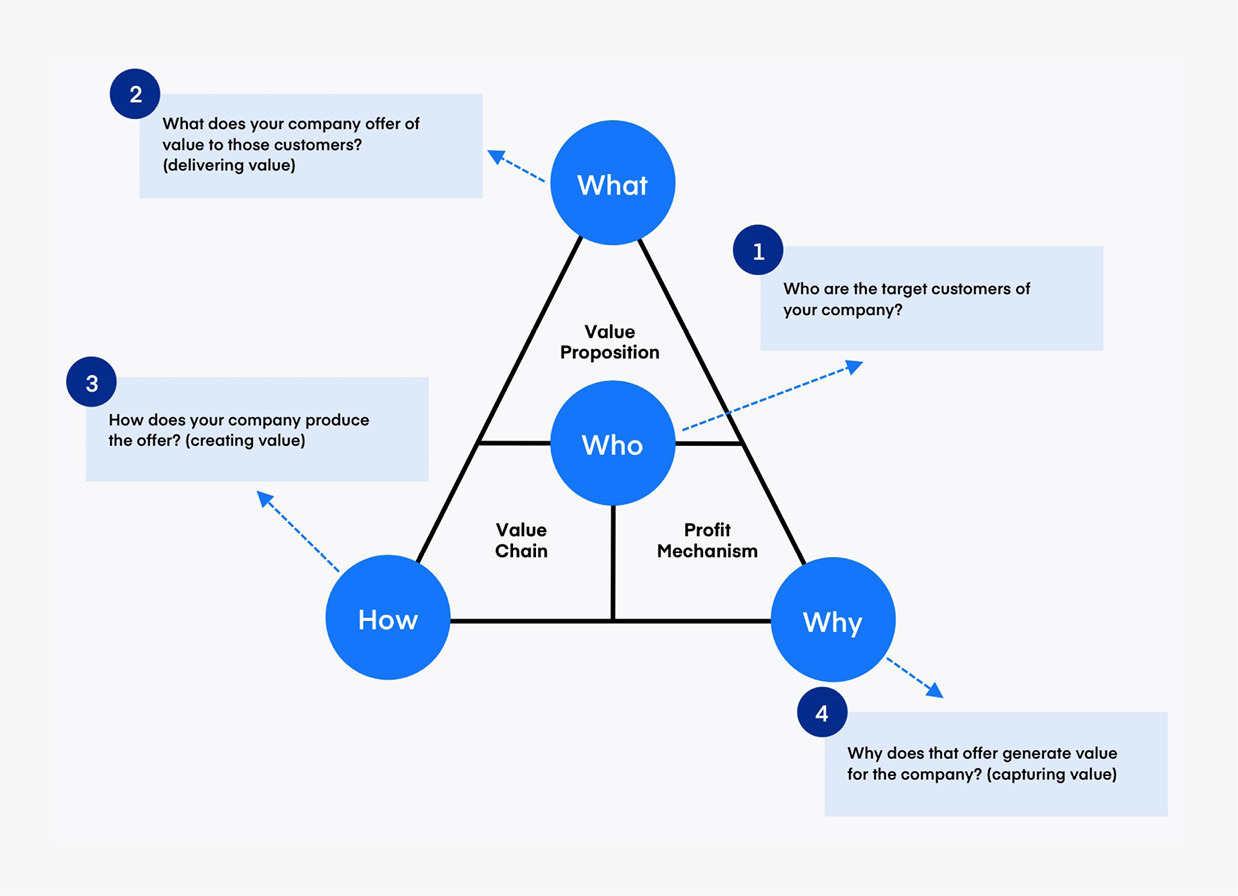
Figure 3-1: Business Model Innovation Framework – the “magic triangle”
After drawing the diagram, the next step is to provide two to three answers per question. Start with the target customers, then the value provided, how it’s provided, and why it’s valuable to the company.
As an example, here’s a business model I created for the online payments processing company Stripe (Figure 3-2). Stripe targets organizations that want to accept online payments in a seamless and simple way. To reduce the complexity and time it takes to integrate these systems, Stripe provides a “seven lines of code” solution for accepting payments. Using the questions, I formed a quick hypothesis of the business model I’d be willing to put in front of my business partners.
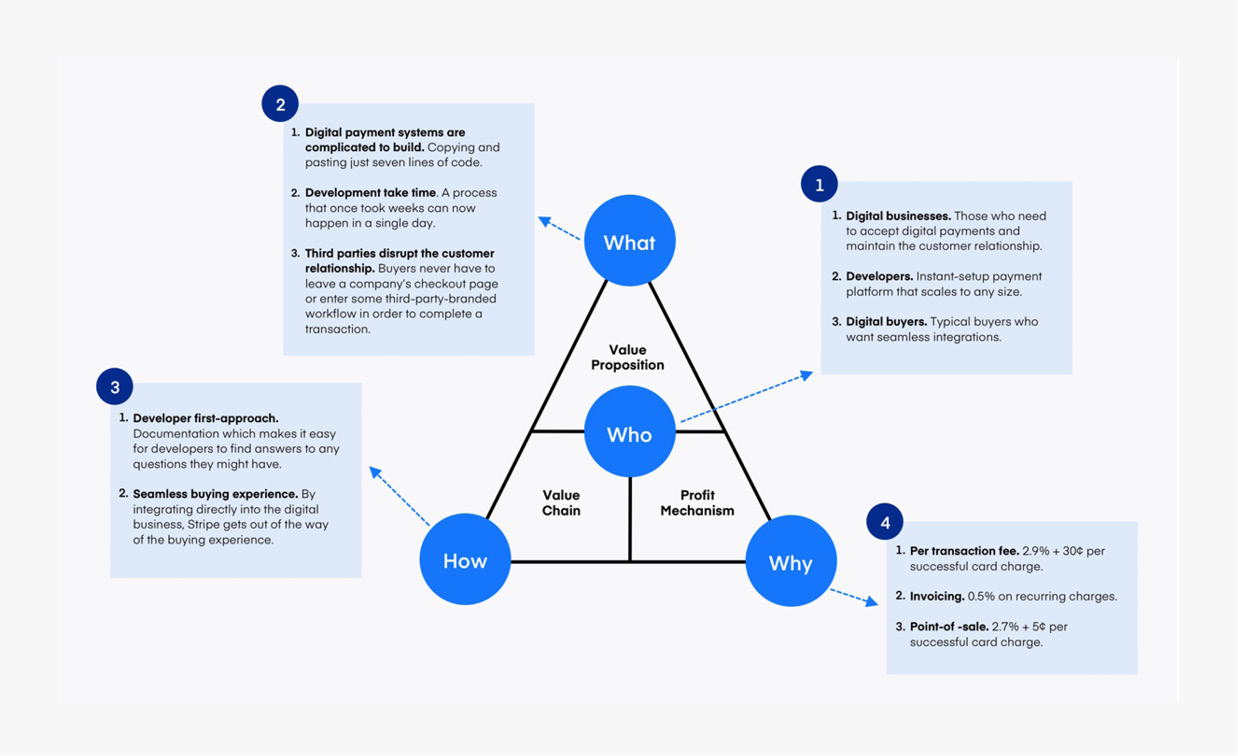
Figure 3-2: A example of the BMI “magic triangle” for Stripe
The EcoSystem Map
Now that you have a representation of the business model, the other diagramming tool depicts how the model works. Called an EcoSystem Map, this tool shows all the actors involved in a business and the flow of value between them. Think of it as a flow chart of the transactions between a business and its suppliers or customers. (“We give you X and in return you give us Y.”)
The EcoSystem Map is my favorite way to quickly understand how the business model works. As a visualization, it has several advantages:
- It maps the big picture.
- It guides discussions with business partners.
- It’s quick to develop and cheap to iterate.
I use the EcoSystem Map with business partners so they know that I understand the business model at hand. I’ve also found that these types of visualizations are something business partners always wanted, but never knew to ask for. It helps identify parts of the model that might not be working well.
Here’s an EcoSystem Map for our example, H&R Block. Even with just a simple understanding of the business model, we can gain a new perspective by quickly drawing out the flow of value.
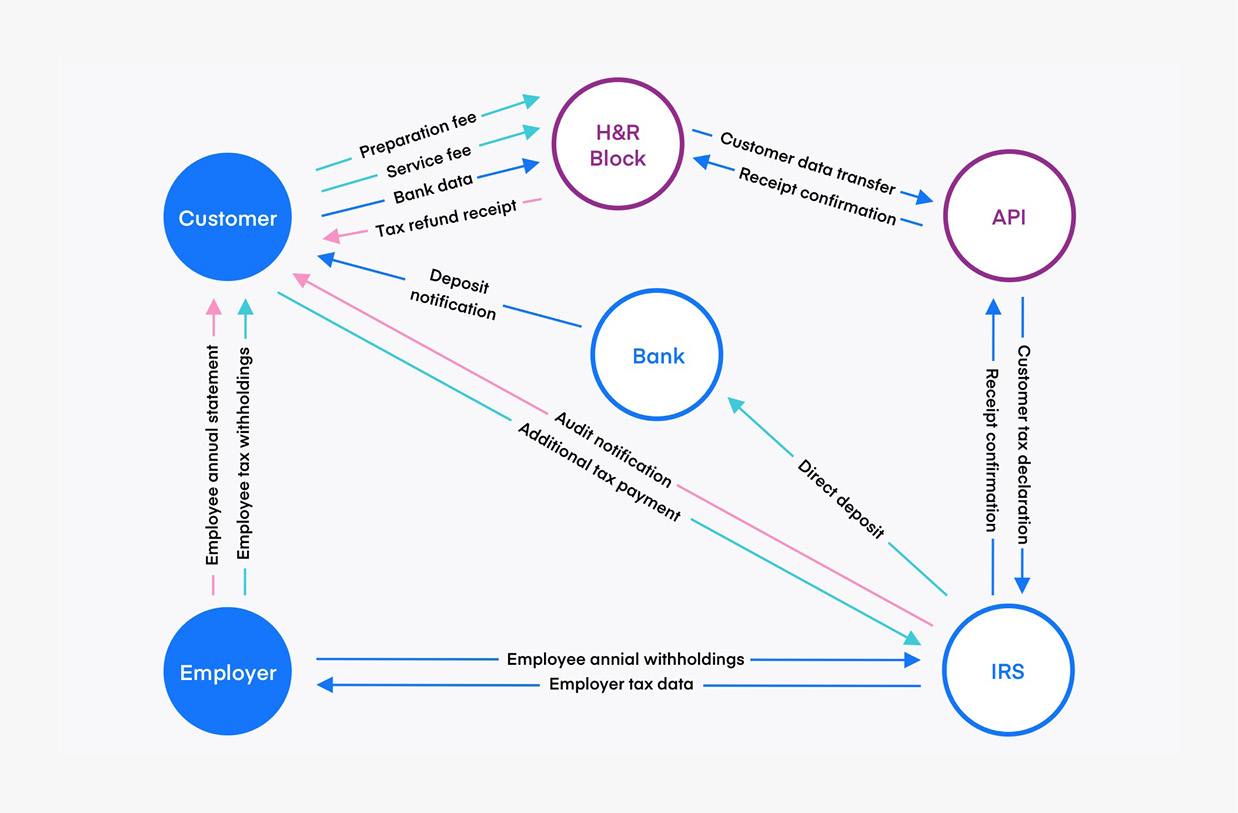
Figure 3-3: A sample of an EcoSystem Map for H&R Block, a U.S.-based tax preparation company
Anticipate your colleagues’ behaviors
As mentioned in Chapter 1, I’m most comfortable in my work when I can anticipate the needs of others. When I couldn’t anticipate what my business partners would do, I began to look for patterns in their behavior.
Sometimes, data was used to make decisions. Other times, the most senior person in the room would just say what they wanted and everyone would scramble. I noticed rules of business would change from room to room, and in order to influence change, I had to take a new approach.
Changing human behavior is hard. B.J. Fogg, a behavior scientist, author, and founder and director of the Stanford Behavior Design Lab, is one of the leading behavior change experts in academia. He’s worked with startups around the world to develop new strategies for behavior change, using his Fogg Behavior Model (FBM).
> Behavior (B) happens when Motivation (M), Ability (A), and a Prompt (P) come together at the same moment.  - BJ Fogg, PhD, Behavior Scientist at
Stanford University
- BJ Fogg, PhD, Behavior Scientist at
Stanford University
Simply put, the FBM states that any behavior will only happen when three elements converge at the same moment in time. These are the three elements:
- Motivation: A person is sufficiently inspired to engage in a behavior.
- Ability: A person is capable of performing that behavior.
- Ability: A person is cued, triggered, called to act, or requested at the right time.
As I began looking for patterns in behavior, I realized I didn’t know what motivated my colleagues. I didn’t know what skills they were capable of performing, what they paid attention to, or how they were responding to my cues. To better anticipate the behavior of my colleagues, I had to get to know them better.
Start with empathy
Trust is a foundational element of any good relationship. Whether you’re new to a role or have challenges with an existing work partnership, it’s natural to want to jump in and start “fixing” things right away. But don’t rush to act. Instead, spend some time building understanding and trust.
To do this, you need the answers to two basic questions: “Who are you working with?” and “What are they trying to achieve?”
Empathy Maps are a great visualization tool to quickly capture “good enough” answers to these two questions. The exercise helps you to understand partners in a new way so you can empathize with their perspectives.
Empathy Maps
You may already be familiar with the Empathy Map, which was originally developed by Dave Gray. Traditionally used as a quick way to develop empathy for customers, the maps are now used by business teams around the world to improve cross-functional partnerships. Since it was released, the tool has undergone many iterations by different users. But my favorite is the 2017 version.
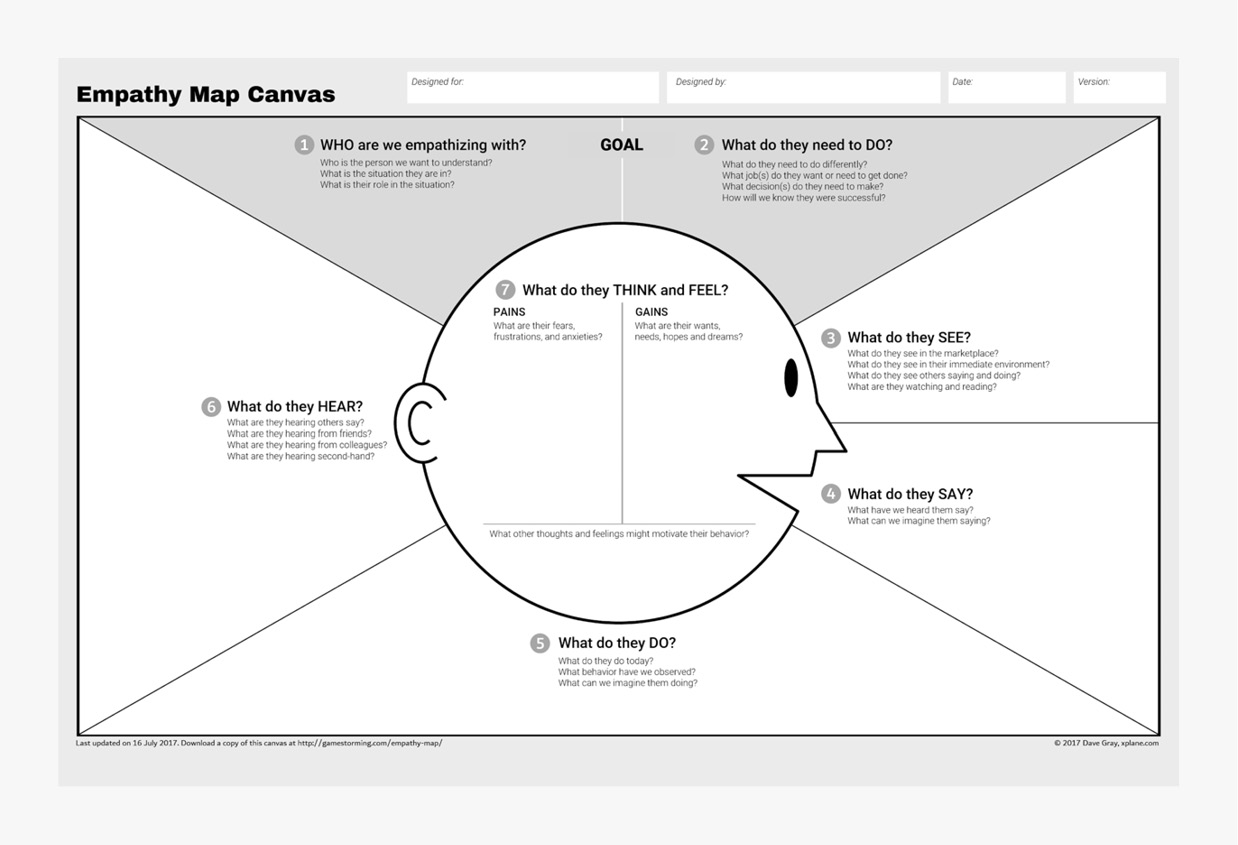
Figure 3-4: Empathy Map from Dave Gray
As an exercise, the Empathy Map first walks through a step-by-step process to identify a specific person and their goal, and then views the work ahead through their eyes. Doing so gives designers a better understanding of what business partners really think and feel about design work, processes, and approaches.
Best done as a team activity, the diagram is structured around seven basic questions:
- WHO are we empathizing with?
- What do they need to DO?
- What do they SEE?
- What do they SAY?
- What do they DO?
- What do they HEAR?
- What do they THINK and FEEL?
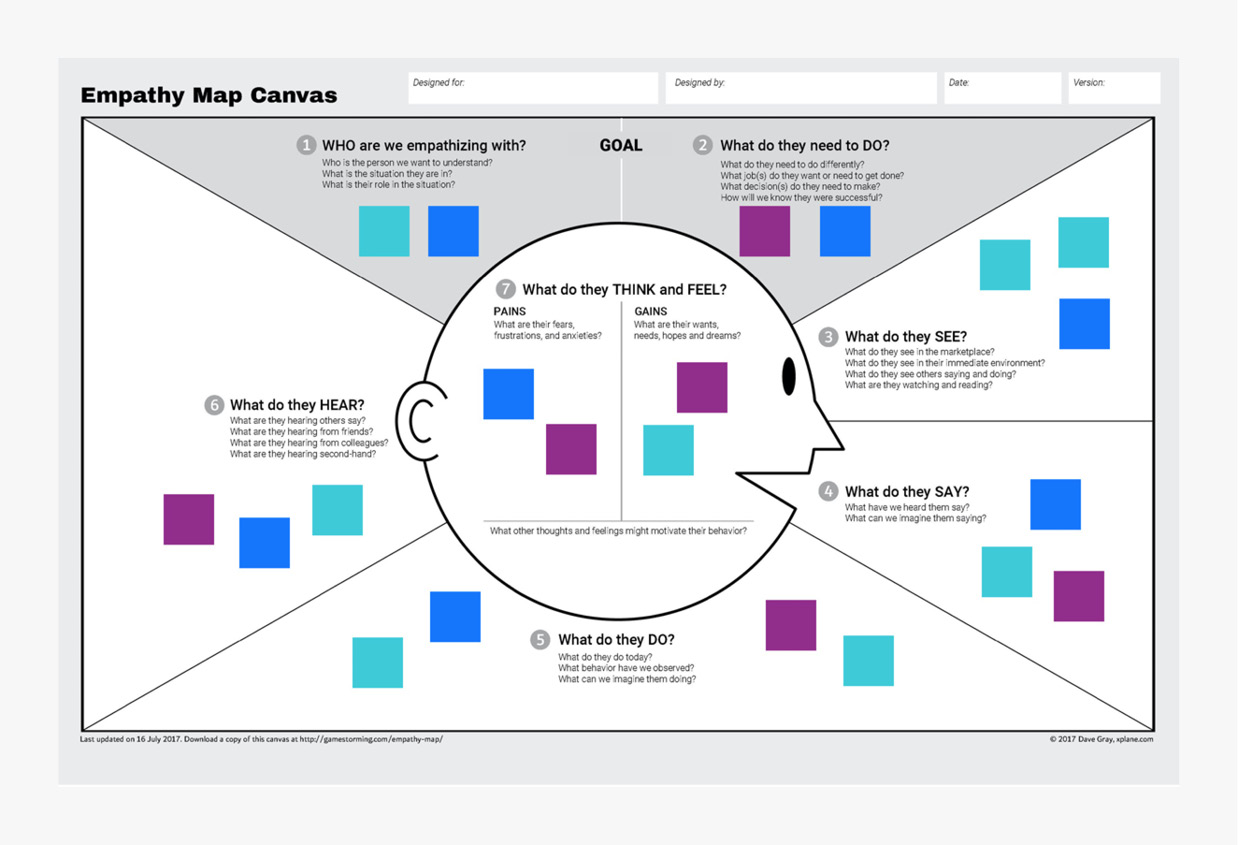
Figure 3-5: A completed Empathy Map
A team can put as much fidelity into the exercise as they want, but 20 minutes should be enough time to develop a rough profile. Answering these basic questions provides three benefits:
- You clarify the intended goals a partner is looking to achieve.
- You identify what your colleagues are on the hook for, how that makes them think and feel, and how those responsibilities influence what they say and do.
- You realize that our partners are not anti-design, but have different perspectives and ways of working.
Once the exercise has been completed, it’s important for the team to be able to summarize the insights in a clear and concise way. Insight Statements are helpful to highlight new key findings.
Insight Statements
Insight Statements allow you to synthesize and frame the information from the Empathy Map into a simple overview. They provide a quick view into what you’ve learned by empathizing with your partner(s). Here’s an example of how to quickly build an Insight Statement.
Something new or novel I learned about [Partner name] was _______.
This knowledge helps validate/invalidate my assumption about _______ .
_______ is a pressing question [Partner name] has that I can now provide an answer for.
_______ is a plausible thing the design team could/should do moving forward to help [Partner name].
There is an opportunity here for us to _______ together.
Once Insight Statements are formed, you have the basis to ask yourself how you might become a better collaborator and partner. You’re now ready to take on business culture.
Pro tip
Empathy Maps and Insight Statements are great team-based activities. Set aside a two-hour block with your teammates, grab some Sharpies and Stickies, and develop ideas together.
Map the business culture
There’s another side of business that’s much more complex than the model or strategy but equally important to understand. It’s how business gets done.
Executive stakeholders have the power to say “yes” or “no,” and it’s up to us to figure out ways to win them over. When there’s a lack of clarity around decision-making, designers are likely to feel frustrated. Conversely, when designers better understand how those leaders make decisions, they feel more engaged and have more trust for their teammates.
In either scenario, designers need pragmatic approaches to map these cultures of decision-making. My favorite tools for the job:
- Team Mapping Tool
- Stakeholder Analysis
- Force Field Analysis
These tools give designers the means to quickly visualize culture in a workplace—from stylistic preferences of decision-making to mapping organizational power dynamics and willingness to change. The tools effectively find gaps in communication to identify advocates and detractors of design and form a strategy for whom to partner with and when.
The Team Mapping Tool
Time and time again, culture trumps strategy. What sounds like a simple and straightforward plan quickly evolves into different expectations of what the design should be. What works for one stakeholder is not working for another, and people in the room seem to be speaking past each other rather than listening.
These are not great conditions to make quality business decisions and it’s not the time to try and address the misalignment. While strategy can be captured, culture is much more difficult to pin down. Next time, try a different type of preparation.
In her book The Culture Map, Erin Meyer introduces a visual diagramming tool called the Team Mapping Tool to help teammates better understand the cognitive, behavioral, and relational differences between one another. As a professor at INSEAD, a top international business school in Paris, Meyer developed this tool for organizations as a way to decode cultural differences so teams could better work together.
The tool includes a total of eight cultural dimensions with ranges of differences for each. As a quick workshop activity, this tool helps design teams understand how their preferred methods and styles of communication, decision-making, persuasion, etc. may be different than their cross-functional partners. The basic process of mapping out these cultural differences is as follows:
- Identify stakeholders.
- Use Post-its to plot the observed styles of each across the eight dimensions.
- Draw a simplified culture line to connect dimensional differences.

Figure 3-6: Example culture lines in The Culture Map
By taking a little time up front to understand differing cultural styles of stakeholders, you can speak directly to their comfort zones. Your colleagues will appreciate your understanding.
Pro tip
If your colleagues are successful at getting stakeholders to make tough decisions, ask them for their presentation documents. Rather than reinvent the wheel, reverse engineer what has worked previously.
Stakeholder Analysis
Designers need to create, deliver, and capture value for colleagues. But introducing new cultures of design and modern development practices can be hard, especially when your company has done things a certain way for a long time. While your ultimate goal may be to help transform a company into one that’s customer-led, it’s important to pick and choose your partners strategically along the way. You need to find your allies.
Stakeholder Analysis is a great way to select strategic partners. Utilizing a two-by-two grid, you can quickly map who has power/influence in your workplace and who is willing to experiment with new ways of working. As you may have guessed, this is called a Stakeholder Map.
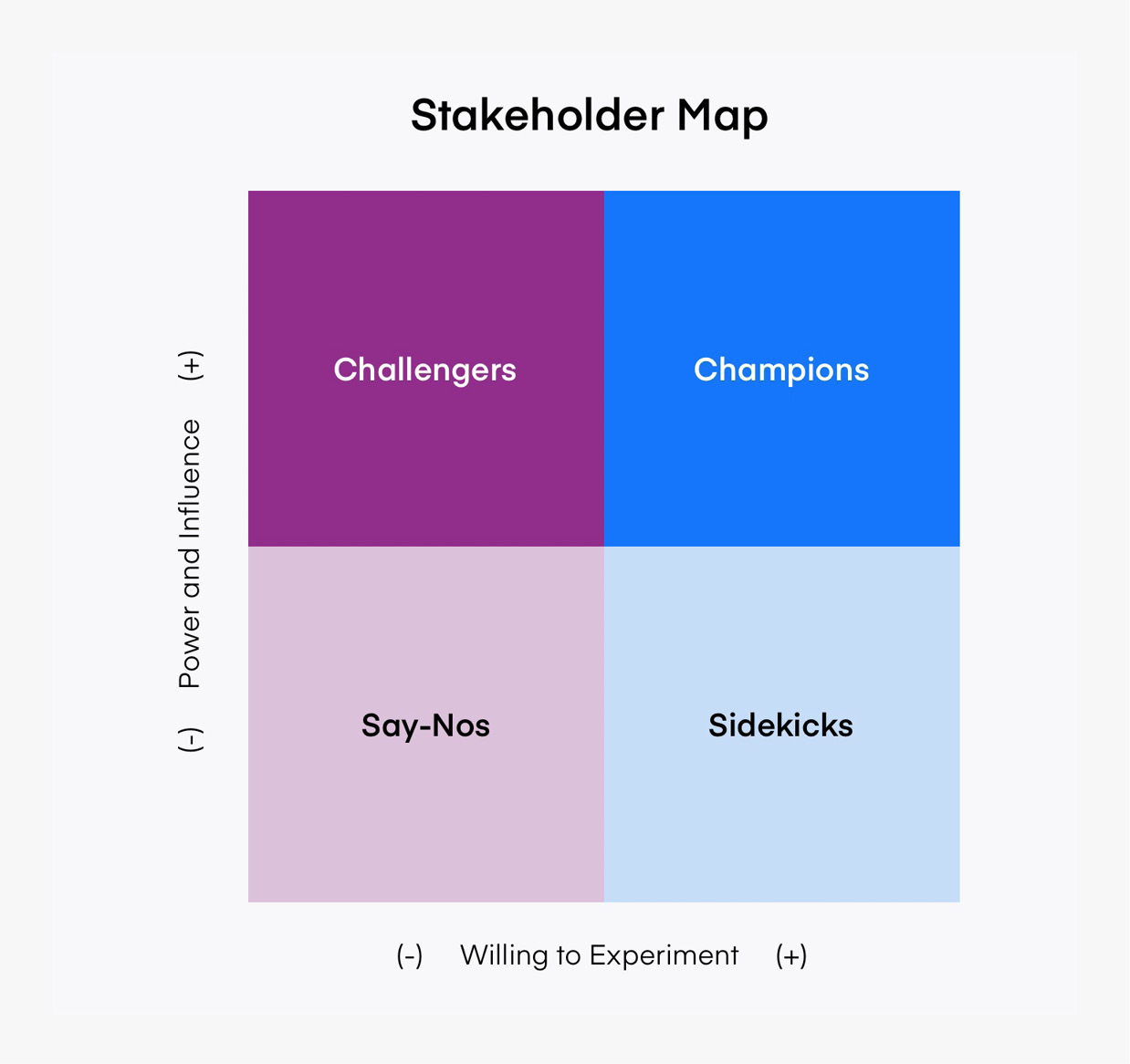
Figure 3-7: An adapted version of a Stakeholder Map by Ryan Rumsey
In my adapted version of the Stakeholder Map (Figure 3-6) the purpose of this plot is two-fold: 1) To understand stakeholders who will advocate for design when designers aren’t in the room, and 2) To find “less visible” projects to work on to build case studies of success. The grid is divided into four sections:
- Champions: influential partners who can help drive scalable adoption of design
- Challengers: influential partners who may be skeptical of design
- Sidekicks: partners willing to experiment with something new and willing to forgive if the experiment doesn’t go as planned
- Say-nos: partners to politely de-prioritize
While it’s logical to try and work closely with Champions first, it’s better to try new things with Sidekicks. Champions drive organizational change, but they tend to be more risk-averse to making organizational changes without seeing evidence that those changes will be successful. Sidekicks will help you build those case studies of change, and if things don’t go as well as expected, they won’t be so influential as to prevent change in the future.
Force-field Analysis
Designers, you are a force of change and not all partners are ready for that change. In some cases, they are quite resistant. For change to happen, the status quo will be disrupted either when conditions favorable to the change are present, or when forces resisting the change are reduced.
Being able to visualize problems gives you a leg up in understanding the whole problem. Force-field Analysis is a great visualization tool used to evaluate when the conditions are ripe for change. It’s a rapid way of examining the forces both for and against a change. This helps determine whether or not teams should move ahead (with confidence) with the proposed change.
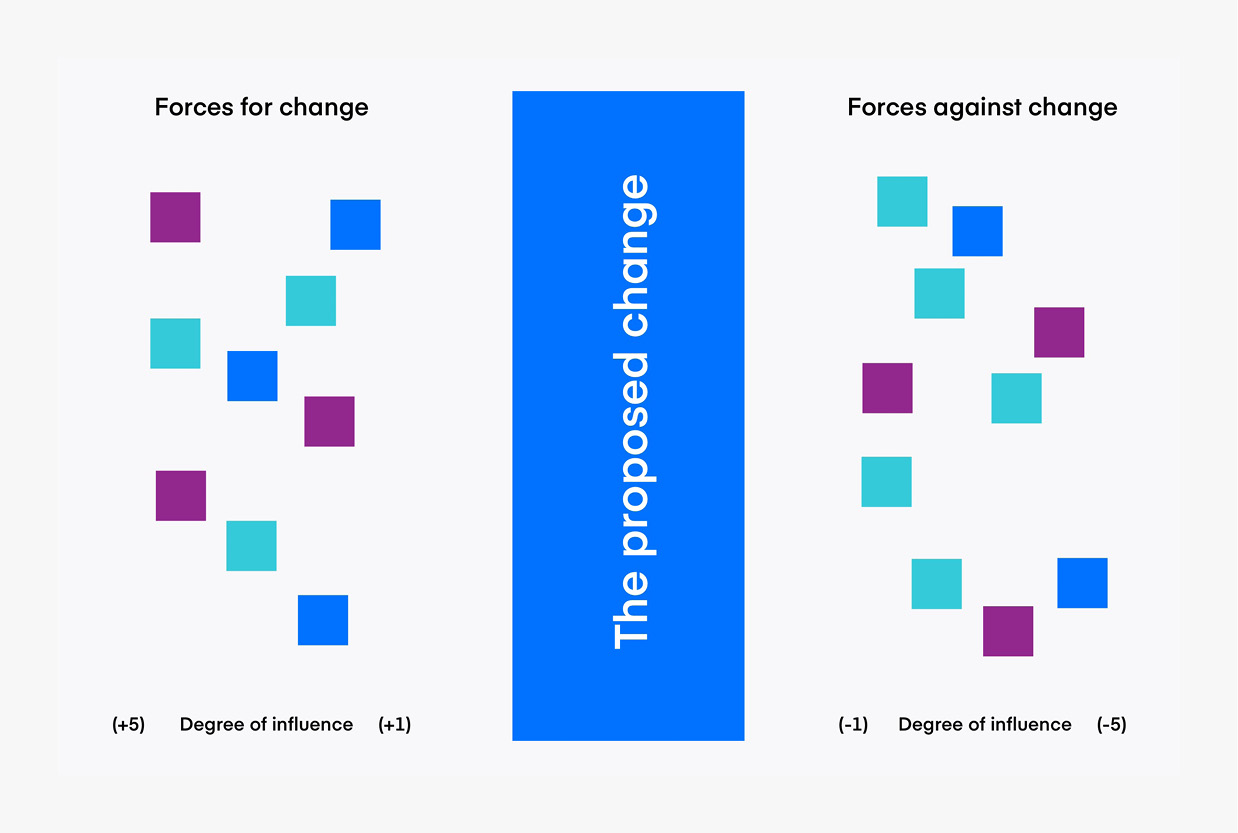
Figure 3-8: Gauging forces for or against a change with Force-Field Analysis
The following questions may help you identify forces that will influence the change:
- What benefit will the change deliver to your partners?
- Who supports the change? Who is against it? Why?
- Do you have the resources to make the change work?
- What costs and risks are involved?
- What business processes will be affected?
You can combine the three tools from this chapter on a semi-regular basis to help you better understand your workplace culture and when the right conditions are in place for changing how things get done. They’ve served me and my teams well over the years.
Reflect
By visualizing cultural differences, stakeholder interest, and the forces both for and against change, designers can quickly identify gaps in the value they provide to partners and how they provide it. With gaps identified, you can then conduct a retrospection of how designers provide value to their colleagues.
Atlassian’s Team Health Monitors are fantastic, step-by-step guides to help teams assess themselves across eight different attributes. They identify when there’s a problem with how design teams create, deliver, and capture value for the business and its business partners.
Pro tip
Conduct reflections on a quarterly basis. This will allow enough time to discover new patterns, while ensuring too much time hasn’t passed to build on past discoveries.
Conclusion
As you begin to understand the models and strategies used by the people you work with, you’ll become a better partner and a more influential designer. Using visualization skills will help you and your team quickly understand the business around you. This additional context fills in gaps to the design story at your company.
The next chapter demonstrates how to establish the right conditions for maturing design in your organization. By including a business perspective in your work, you gain a more comprehensive view of what success looks like. This view will push designers and their partners to be more rigorous in the decision-making process.
Further reading
- 6 basic business terms and concepts every designer should know
- The Business Model Navigator by Oliver Gassmann, professor of Technology Management at the University of St. Gallen, Switzerland
- The EcoSystem Map tool
- The Updated Empathy Map Canvas by Dave Gray, founder of XPLANE
- The Culture Map by Erin Meyer, a professor at INSEAD
- A helpful Force-field Analysis article on Wikipedia
- Team health monitors for building high-performing teams by Atlassian

Chapter 4
Create conditions for design maturity
Gain perspective of how design connects to business
InVision’s groundbreaking report, The New Design Frontier, explores the behaviors, practices, and outcomes of high-performing teams in ways that support the ideas in this book. The report identifies five organic levels of design maturity at which design has increasing levels of influence on a company’s bottom line.
One of the biggest jumps design teams strive to make in their maturity is moving beyond design as a service for basic aesthetics and creative problem-solving techniques (Levels 1, 2, and 3) to a model in which design collaborates in strategic decision-making (Levels 4 and 5). I’ve seen many design teams stuck at Levels 2 and 3 because they’re unable to correlate more advanced design activities to business outcomes.
A key paragraph from the report describes what’s necessary for teams at the third level of maturity to progress further:
> When organizations establish the right conditions for design and make room for it in core processes, they also experience deeper customer understanding, bolder exploration and experimentation, and more informed decisions vetted through the continuous testing and learning process design enables.

The New Design Frontier report from InVision
The phrase that catches my attention is, “When organizations establish the right conditions for design and make room for it in core processes...” I’ve never seen an organization organically instill these conditions for designers. To make it happen, designers must step outside their comfort zones and learn the business.
There’s a reason companies like Netflix, Nike, Patagonia, and Tencent continually produce inspiring products, services, and innovations: They have mature design teams that connect their work to the ultimate outcome of their organizations—winning in competitive markets.
**The designer’s job is to create a competitive advantage**
To win in the market, organizations need a competitive advantage: A condition or circumstance that puts them in a better business position than the rest of the field.
If you recall Porter’s Generic Strategies from Chapter 2, there are basic strategies—such as price—that an organization uses to position itself. Beyond these, organizations use more specific business models and strategies to gain a competitive advantage that’s unique to them.
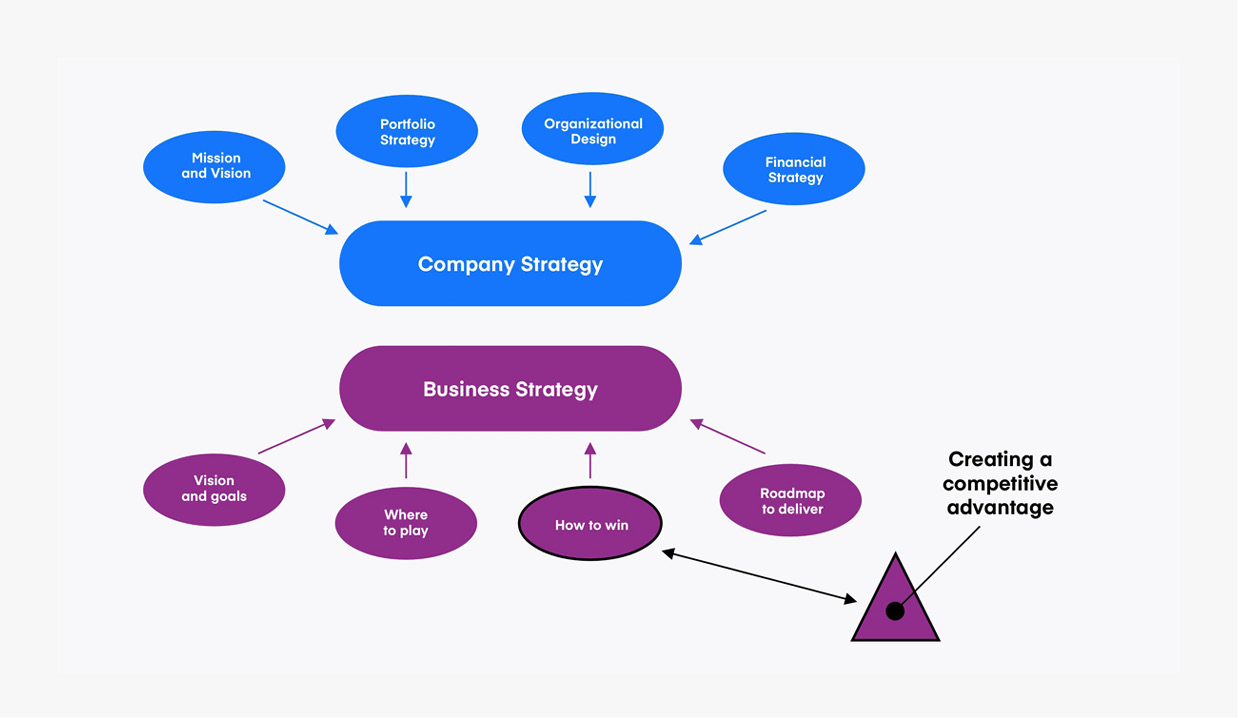
Figure 4-1: Innovations, products, and services are types of approaches companies take to gain competitive advantage, but there are other approaches
Whether you work at a for-profit or non-profit, the designer’s job is to help the organization “win” by creating a competitive advantage. That’s the perspective of the C-suite.
It’s challenging to show executives how the work you do creates meaningful, productive, ethical, and transformative value for customers and achieves a competitive advantage. Establishing the “right conditions” to build maturity means that you must clearly demonstrate how your work with aesthetics, interactions, stories, and brands connects to the company’s bottom line. In this chapter we’ll discuss ways that you can do this:
- Update the Venn diagram
- Visualize the perspectives of desirability
- Connect desirability and viability objectives
- Create a cause-and-effect model with conditional statements
- Quantify results with experimentation
Update the Venn diagram
Terms like innovation, success, and adoption are used a lot in business, but their meanings vary depending on who you’re talking to and their type of organization. Clearly defined and shared definitions for terms is one of the “conditions” necessary for design teams to reach higher maturity levels. It’s a necessary foundation for designers to communicate the value of their work. One way to establish this foundation is to connect these terms to a competitive advantage. Here’s an example of what I mean.
Innovation is one approach to gaining a competitive advantage, and designers are regularly included in these decisions. But designers are often shut out of the process when other approaches are considered. For example, when an insurance company decides to reduce its prices for coverage, or a bank targets frequent travelers for a credit card offer, or a hardware company updates its supply chain.
Shutting designers out of these decisions isn’t malice; it’s a lack of trust. Many organizations aren’t prepared to trust designers beyond aesthetics or problem-solving techniques because designers, by in large, don’t speak about their work in terms of competitive advantage. This is where one of our most sacred Venn diagrams lets us down.
**Business + engineering + design = innovation**
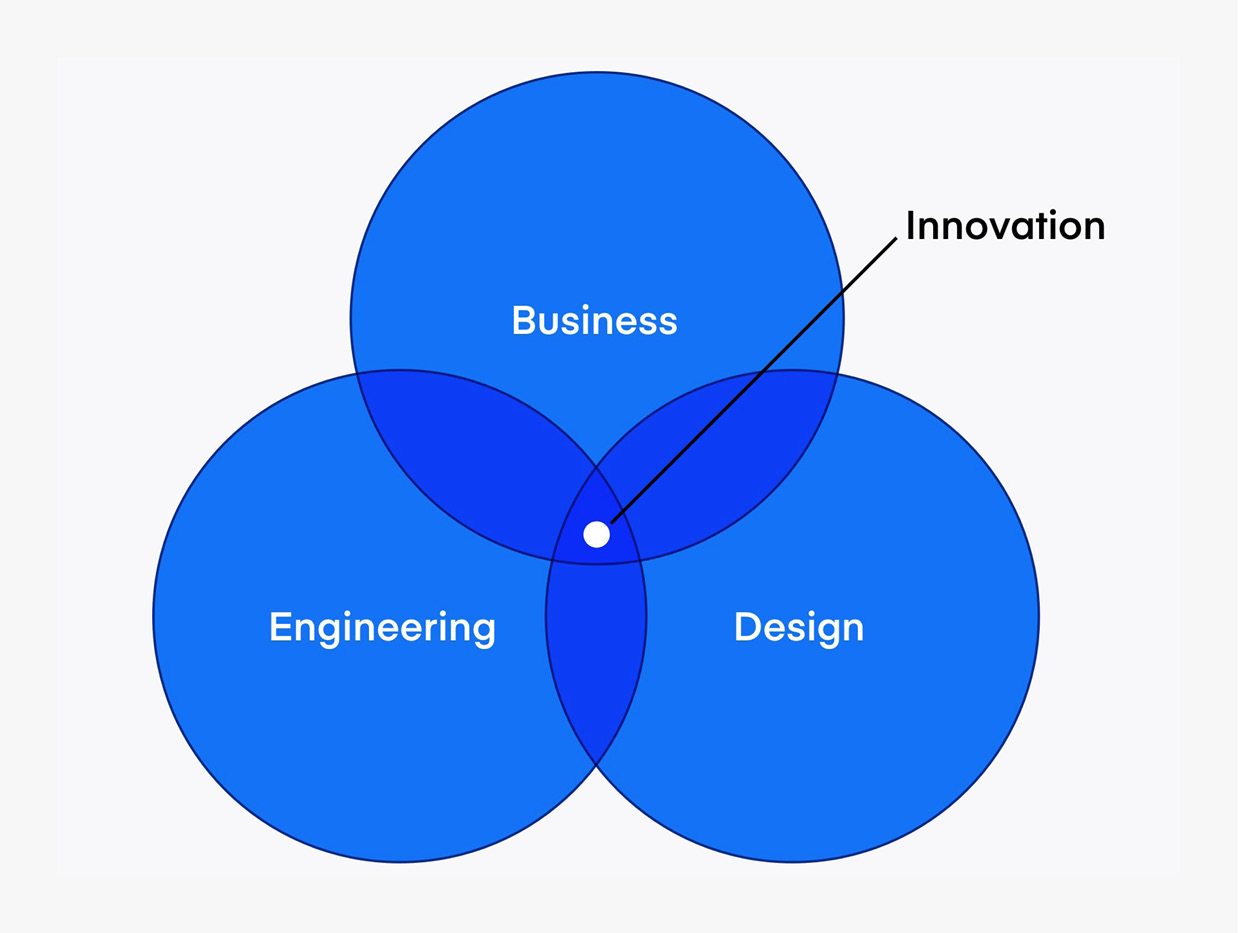
_Figure 4-2: The sacred Venn diagram of innovation_
From a historical perspective, this visualization has been important to promote the need for design to join engineering and business as core innovation disciplines. This promotion has worked. Organizations leverage Design Thinking methods and hire designers to create seamless, beautiful, engaging, and organic customer experiences. However, the diagram is outdated. It oversimplifies how complicated it is to create products and services, and pigeonholes designers into a limited perspective of what innovation means. It does this because it fails to communicate the most basic of business expectations: the link to competitive advantage.
Organizations regularly and wrongly assume that business, engineering, and design functions are enough to create a competitive advantage. But a competitive advantage is only obtained when the characteristics of these functions combine to create desirable, feasible, and viable solutions.
By updating the diagram to reflect this, we can reframe the conversation about the value and fit of design in the organization. This reframing is an important first step in establishing greater trust with our cross-functional colleagues.

Figure 4-3: An updated Venn diagram for competitive advantage by Ryan Rumsey
Business becomes viability. Engineering becomes feasibility. And design becomes desirability. Shifting to desirability means moving away from discussions of aesthetics and towards discussions of what customers actually need and want: desirable solutions.
In addition to evolving organizational functions to product/service characteristics, we should also expand the definition of “innovation.” The word innovation is undeniably exciting to all parties, but when it’s abstract and poorly outlined, it doesn’t merit trade-off decisions.
Innovation is the act of introducing something new or unique. But your organization needs more than this. It needs adoption to validate competitive advantage. This is the value of good design, because desirable solutions are adopted solutions.
Consider this extrapolation of the updated diagram:
- A viable solution, one that’s good for our business
- A feasible solution, one that can be executed by our team
- A desirable solution, one that will be adopted by our customers
Designers who speak to partners about desirability, adoption, and competitive advantage gain trust faster than those who don’t. That said, desire is complex and you need simple ways to describe its unique makeup. That’s what we’ll cover next.
Pro tip
If you have a business partner who asks why you’re not “doing it like company X,” a great response is: “Because we’re not designing for the values of company X and their customers. We’re creating a competitive advantage for us.”
Visualize the perspectives of desirability
_What is desirable?_ This is one of the first questions I ask when I join a company, consult with design teams, or mentor design leaders.
I have yet to ask this question and get the same answer twice. Within an organization, this lack of consistency puts designers and design teams into difficult situations. Business partners expect to get the same answer to this question from every designer in a company. Why? Because designers are ambassadors of desirability for their organization.
Time and time again, I see designers on the same team or in the same organization give different interpretations of what makes a product or service desirable. This confuses business partners and makes them believe desirability is subjective—and therefore unworthy of trust in decision-making.
How do we fix this situation? In my experience, the tools we use to conduct our analysis and develop insights are too complex to share with business partners. Plus, they don’t really remove the subjectiveness of desirability. Journey Maps and Service Blueprints are incredibly powerful and useful. But they don’t directly show how improving an experience leads to objectives and goals for adoption.
So we have a communication gap. Product teams, stakeholders, and executive leadership struggle to connect the dots between desirability and adoption. Strategy Maps are the bridge we need.
What are Strategy Maps?
Strategy Maps are one of my favorite business visualizations. Simple in structure, a Strategy Map shows the relationships between organizational objectives through underlying quality perspectives.
Strategy Maps were originally popularized in the 1990s as part of a strategic management framework called The Balanced Scorecard. Now they’re a popular tool for describing and visualizing business strategies at companies large and small.
Traditional Strategy Maps connect objectives between the four separate perspectives of company health outlined in Chapter 2:
- Financial
- Customer
- Operations
- Learning & growth
The visualization creates a template for how objectives within the different perspectives relate to one another. For example, how developing employee skills relates to improved operational efficiency, which leads to better customer solutions and generates financial value for the company.
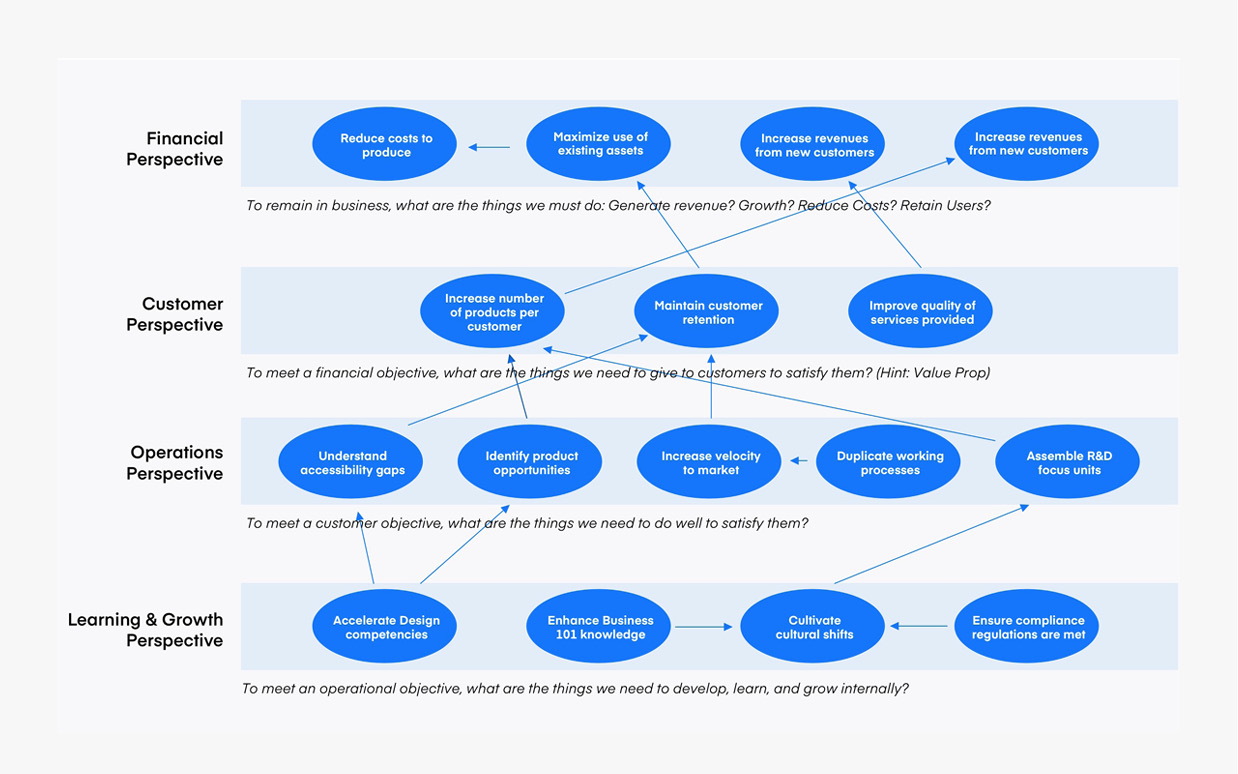
Figure 4-4: A hypothetical example for a business Strategy Map by Ryan Rumsey. At first glance, Strategy Maps can be a little daunting, but by following the arrows we can see how a host of different objectives build on one another
The order of perspectives in Strategy Maps matter because it indicates priority in trade-off-decision scenarios.
- Financial: To remain in business, what are the things we must do? Generate revenue? Grow? Reduce costs? Retain users?
- Customer: To meet a financial objective, what do we need to give customers to satisfy them?
- Operational: To meet a customer objective, what things do we need to do well?
- Learning & growth: To meet an operational objective, what are the things we need to develop, learn, and grow internally?
Developing Strategy Maps is one of the most effective ways to foster the maturity of design teams. Not only do they play to our strength—visualization—but they also unite designers around a common point of view that is vastly superior to an array of personal opinions or feelings.
Now I’ll show you how to create a Strategy Map that communicates your team’s definition of desirability and helps to clarify how designers impact competitive advantage differently than other functions in the business.
Did you know?
Many large organizations already have Strategy Maps for the business. Ask around, get your business partners curious, and see if you can find out if they exist.
Four perspectives of desirability
After 10 years of creating Strategy Maps for design teams, I’ve settled on a format that creates a clear viewpoint on how desirability factors influence adoption.
I use only four perspectives in order to keep things simple for my business partners. And I’ve been able to align most desirability objectives within them without any problem. These perspectives, in order of importance:
- Credibility: To drive adoption, what are the things that need to be credible for the user?
- Impact: To meet a credibility objective, what are the things that must create impact?
- Usability: To meet an impact objective, what are the things that must be usable?
- Detectability: To meet a usability objective, what are the things that must be detectable?
I can’t stress this enough: **The order of these perspectives is important. **
If you want your organization to prioritize factors like ethics or accessibility, you need to first emphasize these perspectives. I place credibility above all others because, ultimately, factors like trust, accuracy, and good intentions matter more than usability. If a customer doesn’t believe your product or service is credible, they’ll quickly take their business elsewhere.
This setup gives design teams an initial outlook on what desirability is: a detectable, usable, impactful, and credible customer experience.
Pro tip
While I find these four perspectives on desirability to work quite well, you might want to consider your own. Here’s a design team activity to do that. I call this exercise Best Product Ever. Prompt team members to think of the best product they have right now and ask each to find four words describing why it’s the best. Use Post-its and affinity diagrams to converge on four perspectives that work for you and your business partners.
Create desirability objectives
After you establish your four perspectives, it’s time to capture two to three strategic objectives for each perspective. These objectives are where you clearly associate values like the environment, trust, society, ethics, diversity, or inclusion with the importance of usability, functionality, or aesthetics.
The easiest way to express an objective is with a phrase that combines a verb and a specific noun. For example, “improve trust,” “increase inclusion,” or “reduce errors.” Once you’ve captured your team’s goals, align each to the specific perspective with a simple chart like the one below.
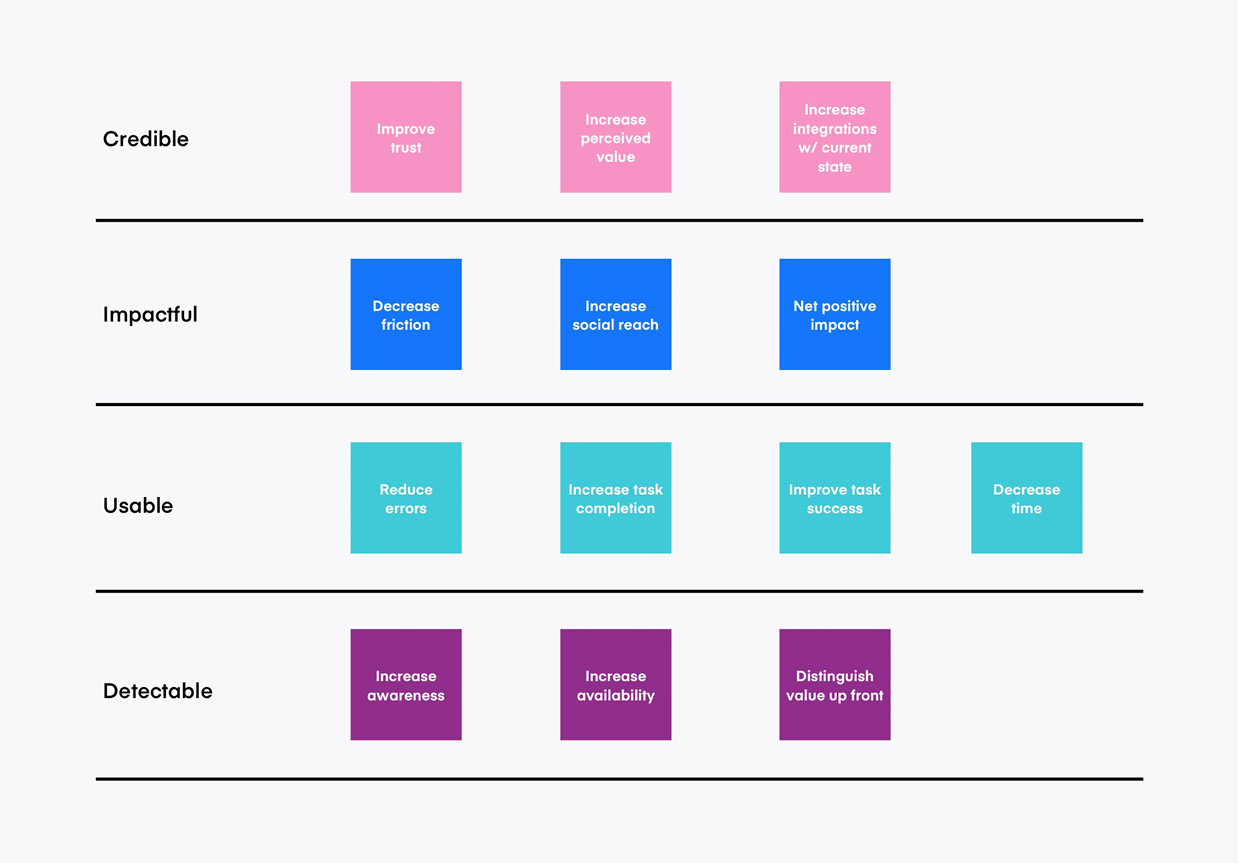
Figure 4-5: Desirability, strategic perspective, and objectives by Ryan Rumsey
As you add objectives, a more refined model of desirability emerges. But we’re not done yet. To integrate with the rest of the business, we need to link desirability to viability. We do this with two elements: arrows and conditional statements. I’ll show you how in the next section.
Link desirability to viability with conditional statements
A common dilemma designers face is when a colleague who has not participated in observations provides a conclusion. When this happens, your other colleagues do what’s natural: they base their own guess on their past experiences or prior knowledge. This is problematic because it leads to inaccurate conclusions across the board and difficult political situations.
One common approach to working through this dilemma is to expose colleagues to users. But another helpful approach is to show your logical reasoning. Conditional statements are a great way to do this.
Conditional statements are formed by connecting two separate statements. The first provides a hypothesis and the second, a conclusion. If you’ve ever developed an app or written code, you’re familiar with “if/then” and “if/else.” These are examples of conditional statements.
Conditional statements create a cause-and-effect model in which being successful with one statement promotes the success of the other. This is where the beauty of visual diagramming comes into place. Rather than trying to write out these statements, you can illustrate them using arrows.
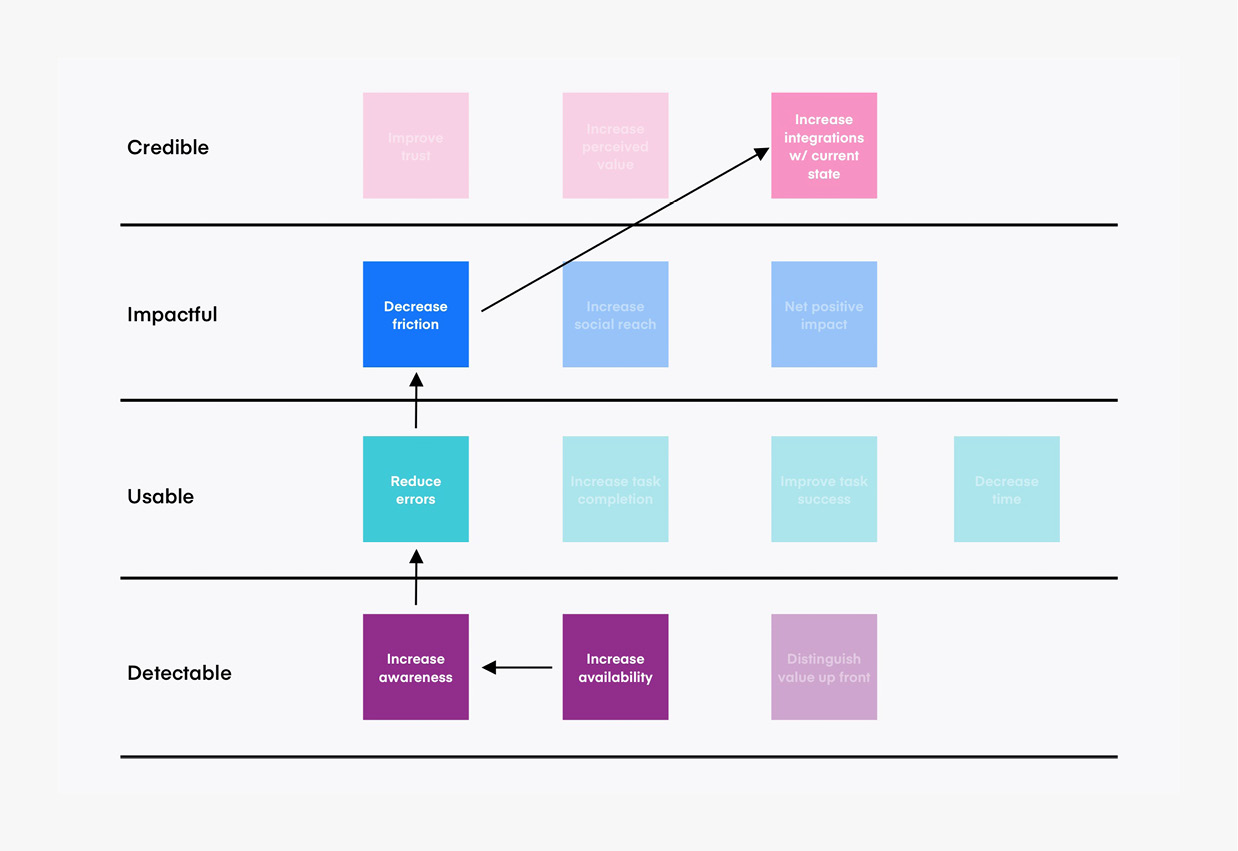
Figure 4-6: A cause-and-effect model of desirability objectives by Ryan Rumsey
To illustrate a single conditional statement, simply draw how you believe the objectives connect to one another. The goal is to draw out multiple statements like this, moving from objectives at the bottom to the top.
Here’s an example of how one of these conditional statements might be written out:
> If we increase our availability, then we will increase awareness, which will reduce errors, and in turn, decrease friction to result in increased integrations.
While it may not be perfect, it’s one complete conditional statement of why desirability matters and how specific objectives relate to overall adoption. We’ve now reached the point where we can make the breakthrough connection to viability.
Connect desirability objectives to viability objectives
Now that you have your conditional statements for desirability, another Strategy Map will help us show the relationships between desirability and viability. Begin by isolating one conditional statement for desirability and creating a second, adjacent column (see below).
Remember those four perspectives of company health? Those are the underlying perspectives of viability. Like the perspectives we captured for desirability, we have to stack rank the perspectives of company health. If you’re working at a for-profit company, the order is: Financial, Customer, Operational, and Learning & Growth. For a non-profit, Financial moves to the bottom.
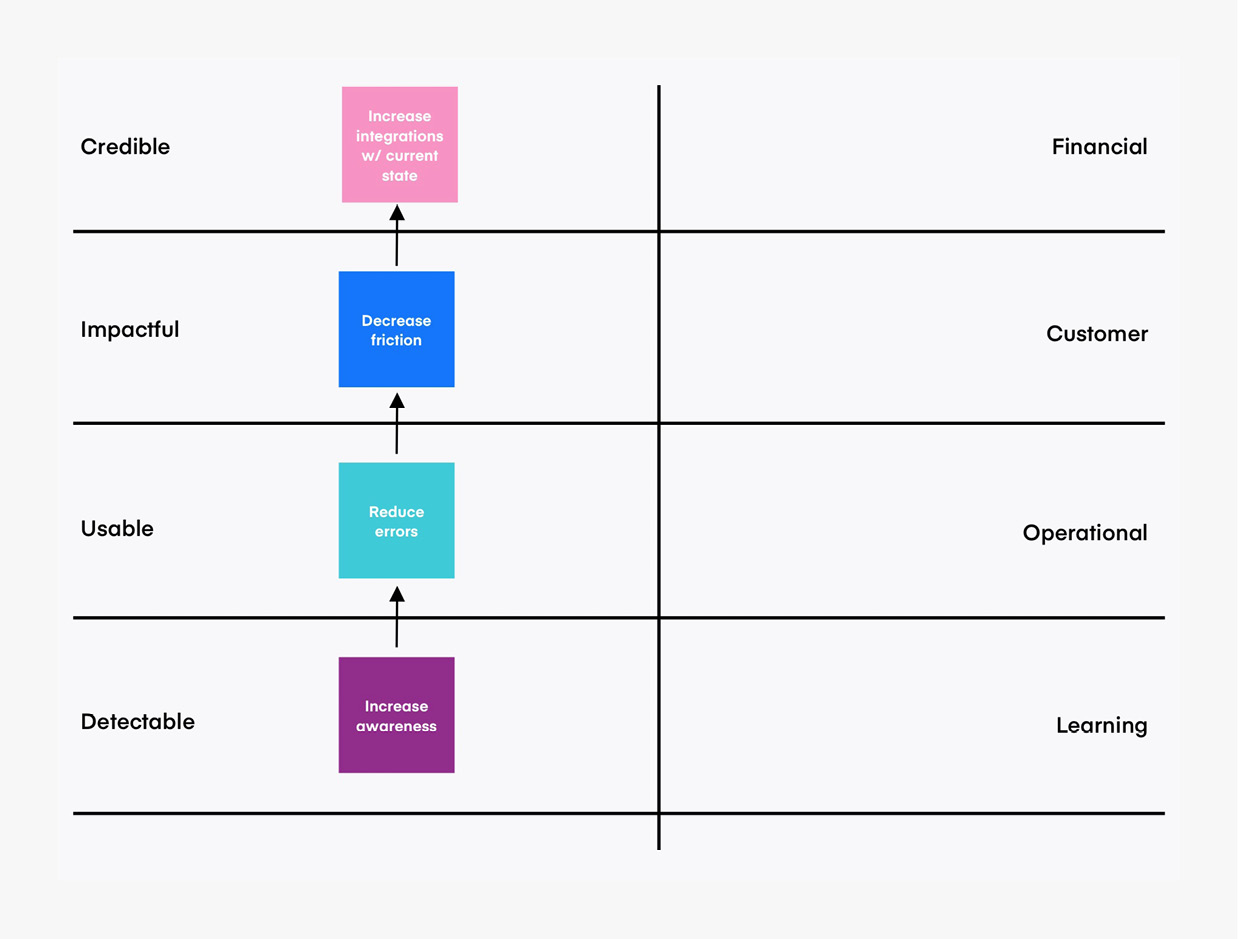
Figure 4-7: The cause-and-effect model of desirability objectives by Ryan Rumsey
In the viability column, capture the objectives of the product you’re working on and align them to the viability perspectives. Typically, these objectives come from your product partners or team leaders. If you don’t know the strategic objectives for your product or service, you can use the Strategy Map approach with your product manager to visualize what they might be.
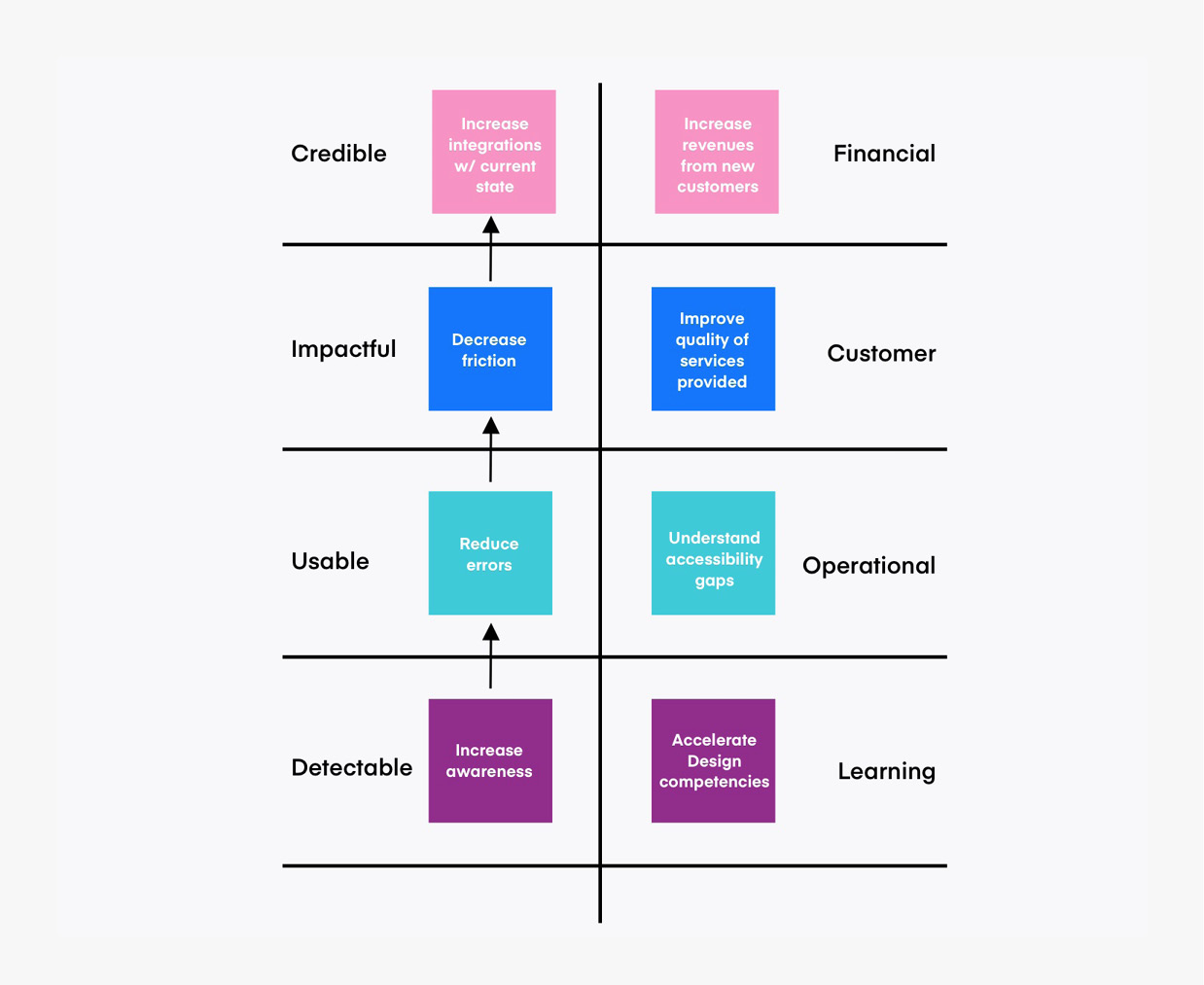
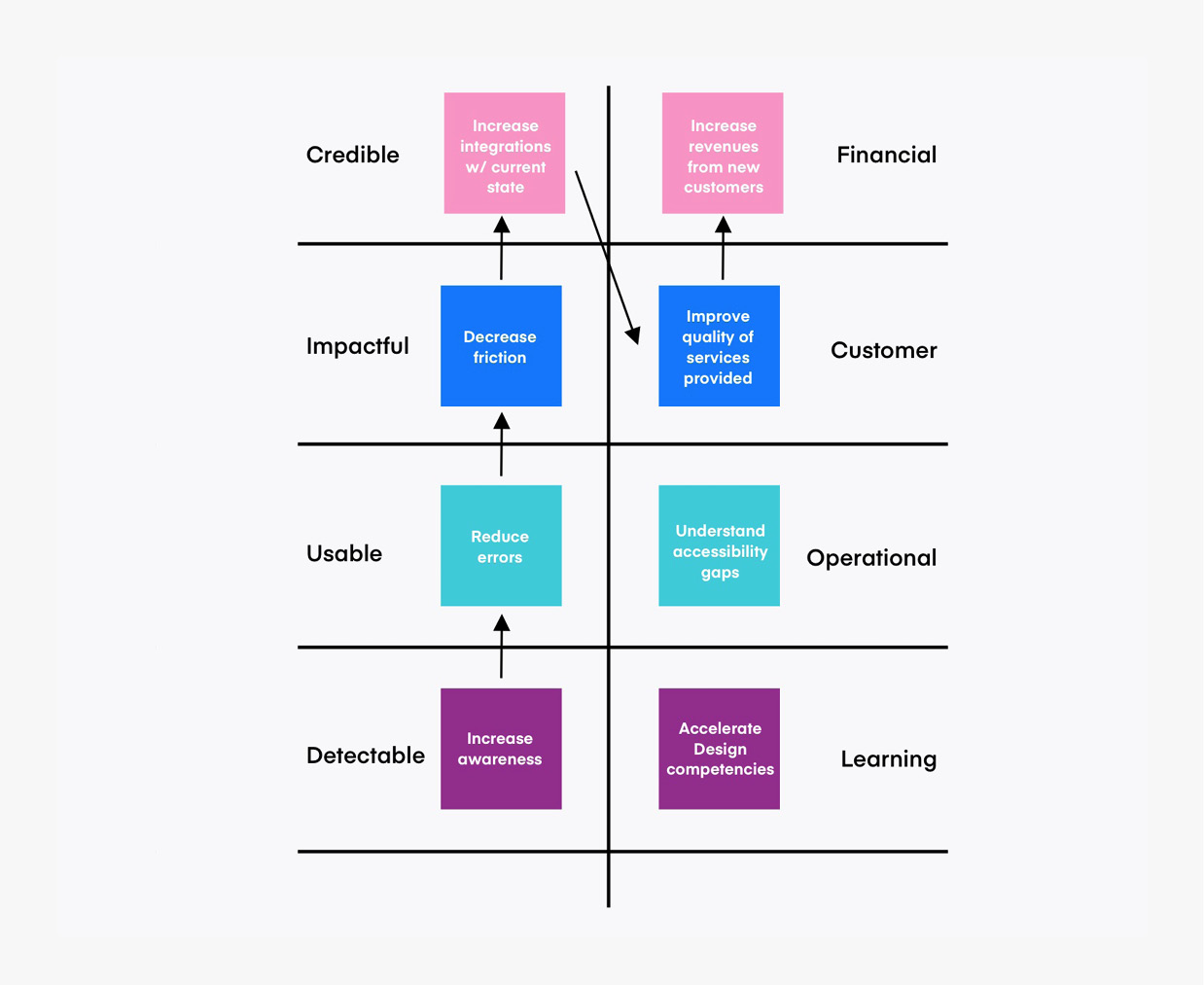
Figure 4-8, 4-9: The cause-and-effect model of desirability and viability objectives by Ryan Rumsey
Once you have objectives in both columns, use additional arrows to extend your conditional statement into the adjacent column by connecting credibility to an objective of viability. As seen below in figure 4-11, you now have a succinct statement of why desirability matters for customer adoption and viability.
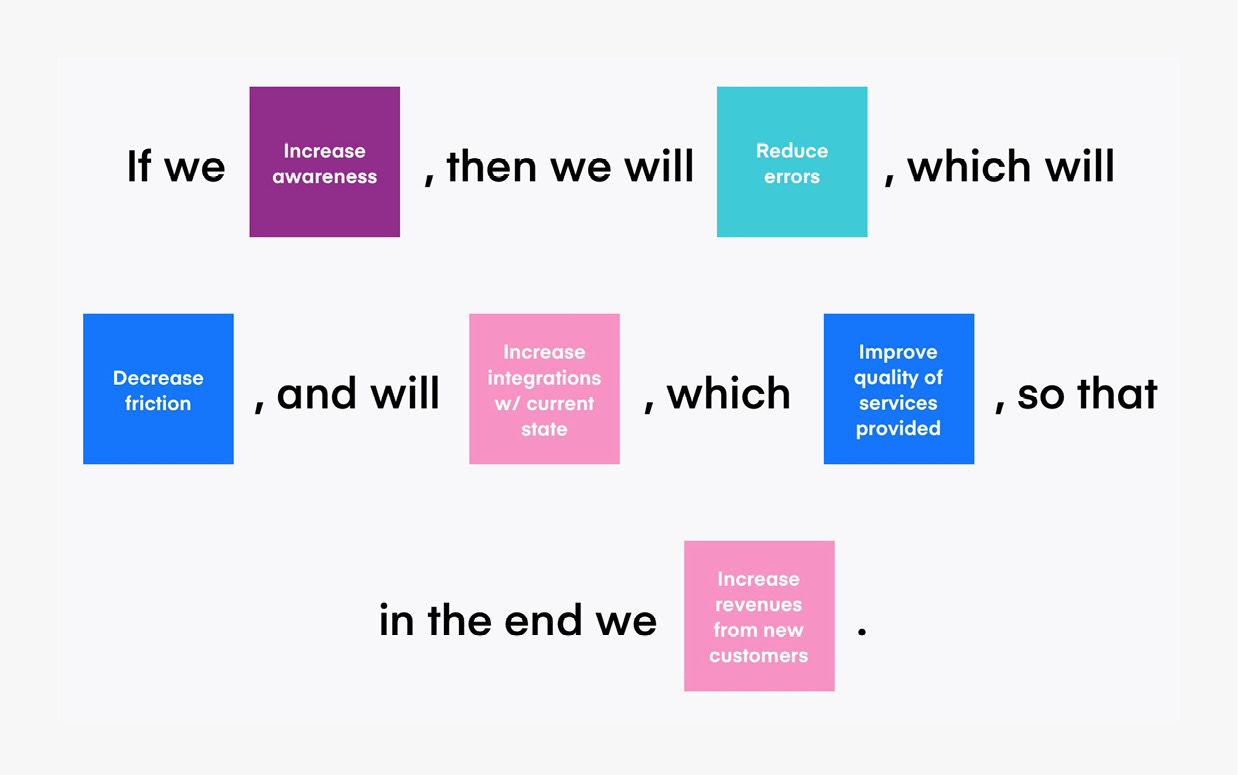
Figure 4-10: A concise and succinct statement to connect desirability to viability by Ryan Rumsey
Congratulations! You’ve just connected design to business and desirability to viability! These conditional statements are now the perfect set-up to frame better experiments moving forward. These experiments are where our next topic—measures and metrics—comes into play.
Pro tip
Prototype your cause-and-effect models with Post-its and Sharpies. It’s the easiest (and cheapest) way to get alignment for teams and stakeholders.
Track goals with experimentation
Design teams at high maturity levels find ways to quantify the value of design to the larger organization through experimentation. These teams create experiments that measure desirability and viability. They also understand that experimentation leads to active learning and the establishment of trust with their colleagues.
> Experimentation is, at its core, about active learning and value creation. To thrive, your team must learn faster than the competition AND convert that learning into value faster than the competition.  - John Cutler, Product Evangelist at Amplitude
The key to creating good product experiments is to start with two viability goals at once: a primary goal that changes and a secondary goal that stays the same. In other words, the primary goal is something the team wants to achieve without losing something else.
For example: _Our (primary) goal is to increase revenue while keeping costs the same (secondary)._
The key to creating great product experiments is to consider two viability goals AND two desirability goals at the same time. One of my favorite methods for validating these types of experiments is described in the book Designing with Data by Elizabeth F. Churchill, Rochelle King, and Caitlin Tan.
A top-down approach for experimentation
Using this structure, product teams have a format to shape multiple hypotheses regarding desirability factors within an experiment.
While the overall purpose of each experiment is to validate whether or not a solution is viable, the purpose of testing different approaches is to validate the degree of viability in relation to desirability goals.
When it comes to measurements, we’re fortunate to have the work of many design leaders who have written on the topic. Whether we use Key Experience Indicators, Usability, Credibility, or other measures, it’s critical to track the effects of your experiments both quantitatively and qualitatively. Having an imbalance in either direction leads to a lot of guessing.
If this top-down approach to experimentation seems too robust for your team’s current maturity level, there’s a simpler approach that also produces good results.
An inside-out approach to experimentation
The inside-out approach to experimentation is one I regularly use. But beware! It involves the question so many designers dread: “What’s the ROI of this?”
Return on Investment (ROI) is one of those conversations many designers aren’t prepared to have. So let’s break it down. When organizations invest in making new products, executives and sponsors want to know four things:
- What do I get?
- How much do I get?
- When do I get it?
- How much will it cost me?
While executives expect to have answers for these four questions, rarely do they ask them and that creates a major communication gap.
When ROI conversations arise (and they will) it’s not only important to communicate if a design works, but also by _how much_. The degree to which a design is successful is an important factor in making decisions about investment. This is what your business partners mean when they ask about the ROI.
Believe it or not, the easiest way to answer the ROI question is to start with math assumptions. Perhaps you’ve avoided math in your career. I did. But it’s going to be OK, because your responsibility is only to highlight when the math doesn’t add up, not to calculate it. Let me explain.
Math must be used to calculate ROI. If math isn’t being used, your business partners are just guessing. There’s no way for you to calculate ROI on desirability factors if the product and business folks around you don’t have legitimate numbers for you to start with. I like to say, _If math is being used, it’s your job to highlight how desirability is impacting the math. If math is not being used, it’s your job to highlight the risks of not using it_.
ROI calculations for digital products are pretty standard. From calculating marketing efforts to rates of retention, organizations use math to determine which solutions are viable or not. By framing experiments around ROI, product teams get scenarios of how well a design worked, which helps them make trade-off decisions.
You’ve stuck with me thus far, so let’s talk about how to crunch the numbers.
Let’s talk quantification!
When numbers do exist, you’re in a great position. Now, when you conduct experiments with specific desirability measurements, your product partners will be better able to calculate viability. Together, these numbers will make a strong case in trade-off decisions.
To get a baseline for quantification, let’s look at an equation for calculating the percentage of customers a company keeps and “retains” over time. To calculate the ROI of Retention, you need four metrics:
- The number of customers you’re targeting
- The current percentage rate of retention
- The projected rate of retention
- The projected rate of retention
Pro tip
Once you know what metrics responsible businesses should be calculating, you can ask whether or not the numbers exist in your company and what numeric goals the organization targets.
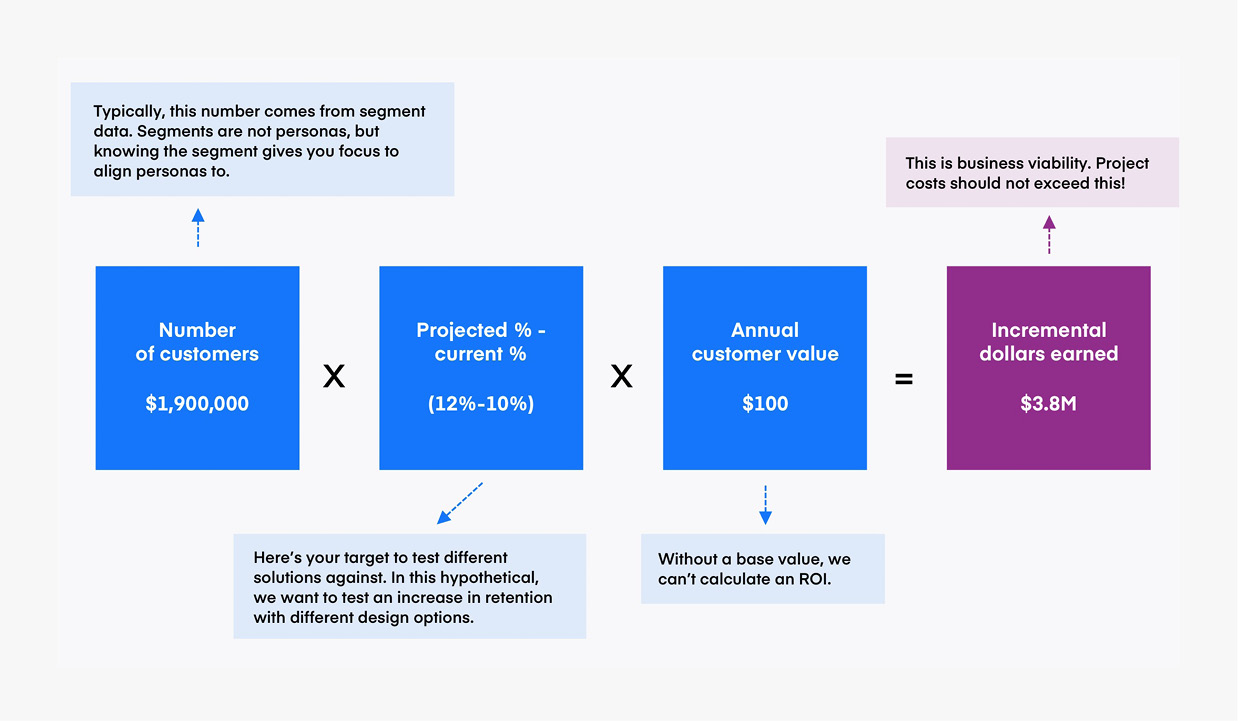
Figure 4-11: Designing for the ROI of Retention equation by Ryan Rumsey
Using ROI formulas is a great way to validate that math is being used and frame experiments for desirability. From looking at the formula in figure 4-1113, you can identify three crucial insights:
- The potential dollars earned for this model is $3.8 million. That’s the target for viability. The project costs involved should not exceed $3.8 million unless value is created in another way.
- 1.9 million customers is a number that typically comes from segmentation data. While segments are not personas, this audience is where the business assumes a competitive advantage can be created. Having a target audience allows designers to focus on personas specific to that segment and to either validate or push back on the assumption.
- Projected and current percentages of retention indicate the viability outcome for an experiment. It’s a target to test different solutions against and in this hypothetical equation, your experiments should test if a desirability metric helps increase retention from 10 to 12%.
Pro tip
Ask your product managers how they’re calculating ROI. To break the ice, you can show them an example formula.
Conclusion
Making minor pivots in how you discuss design work is how you’ll prepare your organization for increased maturity. If your partners ask why you’re not doing what Amazon is doing, tell them you’re not designing for Amazon’s values or customers. But remember, what your business partners really want is viability for the company. So be prepared to take the conversation a step further by showing how the desirability you create connects to viability. Connecting those outcomes isn’t easy, but it must be done.
Also, know that companies support non-traditional factors like accessibility or openess when designers can show that these factors create competitive advantages. This pivot, from describing “what design is” to talking about the “competitive advantages design work provides” benefits both your organization and your customers. And it builds trust.
Further reading
- Four "fits" to make Design crucial at your company
- Designing with Data by Elizabeth F. Churchill, Rochelle King, and Caitlin Tan
- A Strategy Maps 101 video by strategy and performance management specialist Phil Jones
- The New Design Frontier report from InVision

Chapter 5
Communicate the options
How effective communication helps business partners understand design
As mentioned in Chapters 3 and 4, increasing organizational trust is a matter of getting to know your business, your business partners, and aligning your work to viability. In reality though, those steps alone are not enough, because your partners are suffering from decision fatigue.
Decision fatigue is when the quality of decision-making deteriorates simply because there are too many decisions to be made. But designers can help the situation through effective communication.
The ability to communicate clearly is the single most important skill you can develop to mature decision-making in your organization and relieve decision fatigue. Effective communication helps your business partners better understand the opportunities and risks that design identifies.
> For all the value they could create, too often designers appear naive in the face of genuinely understanding cultures of decision-making, of how an inability to generate political capital can undermine their ability to deliver change.  - Dan Hill, author of Dark Matter and Trojan Horses: a strategic design vocabulary
The first step to effective communication is to use languages and structures that are already valued by others. This will help gain trust and influence and lead to more support from business partners (rather than grievances). It’s only when that trust is gained that iterating on the language and structures themselves will be accepted.
This chapter focuses on communication. We’ll review alternative structures for:
- Storytelling
- Presenting
- Analysis
- Negotiation
- Gauging ambition
Identify valued storytelling structures
Designers, while particularly good at developing insights, need to improve how they communicate recommendations, risks, and trade-offs in order to activate those insights. In my experience, Post-its are not especially effective for these types of communications. Nor are sprints, workshops, or diagrams.
Quality trade-off decisions are made when partners understand opportunities, risks, and the choices available to them. Embedding the value of design within a valued storytelling structure is the way forward.
Valued storytelling structures provide familiar patterns of data, insights, and arguments for a plan moving forward. In using a storytelling method which already exists, we hope to:
- Increase the number of decisions made
- Establish trust
- Encourage cross-functional alignment
- Reuse what works
- Reduce formatting churn
If your organization doesn’t have a consistent structure driving decision-making, it can be frustrating. It’s also a good opportunity to borrow from counterparts in the consultancy space.
Add analytical storytelling to your toolkit
Over the last 10 years, narrative storytelling has become a mainstay in the designer toolkit. While wonderful for creating products that resonate with customers, narrative storytelling isn’t enough for making trade-off decisions. The purpose of narrative is to relate a series of actors, events, and actions to an audience through imagery. What it delivers in inspiration, it misses in expressing the reasoning of the storyteller.
To influence decisions, how a story is constructed is just as important as the narrative itself. In trade-off-decision scenarios, your partners need to know why you decided to tell the story in a particular way so they can better understand your rationale and argument.
Analytical storytelling
One of the main reasons organizations hire external, business management consultancies like BCG, Bain, or Accenture is because their analytical storytelling structure explains the rationale behind a recommendation. The structure is predictable and focused on prioritizing difficult decisions.
Analytical storytelling leverages both rational know-how and political understanding in order to present recommendations in a manner suited for a particular audience. It’s a powerful type of communication because it uses structured thinking with trade-off decision scenarios at the heart of the story.
Before diving into specifics on how to develop these types of stories, I have a few guidelines for when to use a narrative storytelling structure versus an analytical one. The guidelines are based on what you want to achieve with your presentation.
**Use narrative storytelling:**
- When you want your colleagues to connect with the customer perspective.
- When you want to inspire or motivate your organization to do something new.
- When your product team needs a compelling vision.
**Use analytical storytelling:**
- When you want to persuade your colleagues to fund an initiative or additional resources.
- When you want to inform partners of multiple paths forward to achieve an outcome.
- When you want to highlight the risks and opportunities ahead.
**Use narrative AND analytical storytelling together:**
- When you want your colleagues to see the value you’ve already delivered.
- Use analytical storytelling first, then narrative storytelling to connect the completed steps to the greater vision.
- When you want to highlight the risks and opportunities ahead.
Becoming familiar with a couple established formats will make you more comfortable participating in or leading decision-making activities with your partners. We’ll look at those in the next section.
Presenting with Pyramid Principle and SCR
When it comes to communicating business rationale, a great communication structure can make or break your presentation. One of the most famous and heavily used analytical storytelling structures is called The Pyramid Principle.
Developed by Barbara Minto, the Pyramid Principle takes the basic elements of a story and organizes them into a hierarchical structure to make them easy for someone else to understand. By using a pyramidal structure, presenters can present a progressive order to their arguments by framing what is known, summarizing logical reasons for action, and ordering the arguments in a way that makes sense to the audience.
The basic elements of an analytical story
The pyramid shape introduced by Minto provides three basic elements of an analytical story: what, why, and how. Represented in Figure 5-1, the form gives structure to your thinking for a presentation, an email, or an analysis.
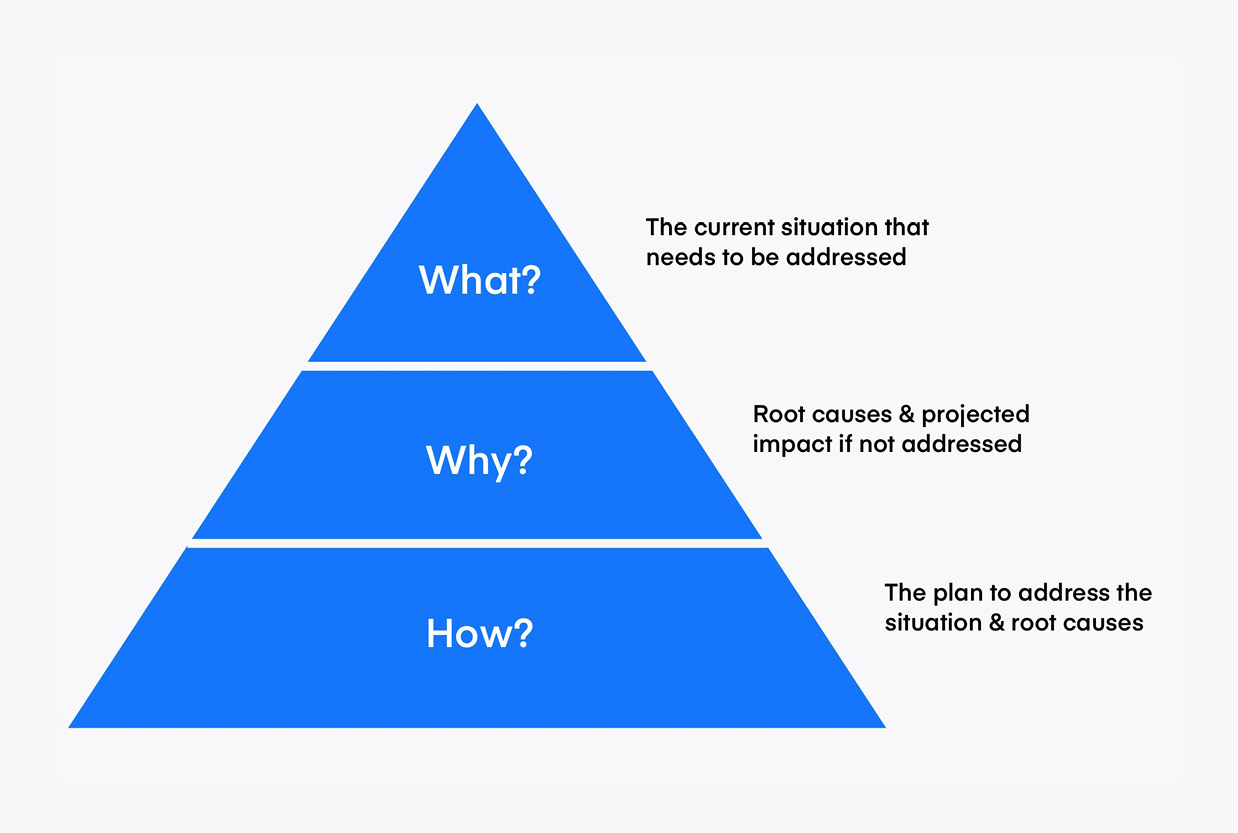
Figure 5-1: Structure your presentation with the SCR format
> The pyramid is a tool to help you find out what you think. The great value of the technique is that it forces you to pull out of your head information that you weren’t aware was there, and then helps you to develop and shape it until the thinking is crystal clear. Until you do that, you can’t make good decisions on slides or video.  - Barbara Minto, Author, Educator, Creator of The Minto Pyramid Principle
From the top down, the pyramid forms the three basic sections and ensures that both your thinking, then your presentation, complete a thought before moving onto the next. By answering in the order of what, why, and then how, you present an analytical argument that your stakeholders can follow.
- What is happening? This first element frames an objective or problem that needs to be addressed. It’s important to start your story here in order to quickly confirm to others that you understand what the key objective or problem is. Typically, this is something all stakeholders are already aware of. If you see heads nodding when you talk about what is happening, that’s a good thing.
- Why is it happening? After summarizing what is happening, it’s vital to review the root causes and impact to customers and the company if the main objective or problem isn’t addressed. It’s in this portion of the pyramid where the majority of data, insights, and conclusions will be placed to support your argument.
- How are we going to fix it? This final section of the pyramid explains how the objective or problem will be addressed moving forward.
Now that you understand the basic structure of the pyramid, I’d like to share an example of an applied version of the structure. In practice, a commonly used version of Pyramid Principle is the Situation-Complication-Resolution (SCR) Framework. While there are other examples, this is a good starting point.
The Situation-Complication-Resolution (SCR) Framework
If you’re familiar with the 5 paragraph essay structure for writing, the SCR Framework is similar. The beauty of it is that it can be tailored for the circumstances of a specific decision.
The framework allows you to structure your argument as a series of situations and complications, which leads to a resolution. The acronym represents the structure:
- Situation: The important, fact-based state of current affairs
- Complication: The reason(s) the current state of affairs requires action
- Resolution: The specific action required to solve the problem—the recommendation
The most basic approach for presenting business rationale with SCR is to highlight one situation, introduce three complications that require action, and conclude with a resolution to solve the problem. I like to think about it like an equation:
> S+C+C+C+R = Business Rationale
From the pyramid structure, the situation is the “what,” the complications the “why,” and the resolution the “how.” With this basic format, a few best practice guidelines can help you develop a more complete SCR story.
Use the rule of three. The rule of three is a writing principle based on how we as humans recognize patterns. Since three is the smallest number of elements required to create a pattern, this principle suggests that using three elements at a time is more effective than using another number. An example of this principle in practice is using three complications to support the situation.
Complications should create tension. Without tension, stakeholders may be less than compelled to act. While design tools like Journey Maps and Service Blueprints are incredibly powerful for developing insights, time and time again I see designers fail to create enough tension from these tools to compel hard decisions to be made.
Support one complication before introducing another. Another mistake I see in presentations is the misordering of slides. Each complication should come with supporting arguments before introducing a new complication. Using the rule of three, include three supporting arguments for every complication. This is essential to both introduce and close a complication, ensuring your audience is able to follow along.
The real power of this framework is translating the structure into slides. The format tells a story where each page answers the question: “And so what?” In figure 5-2, the progressive order of the story being told follows the pyramidal shape, ensuring each part of the story connects with the business rationale.
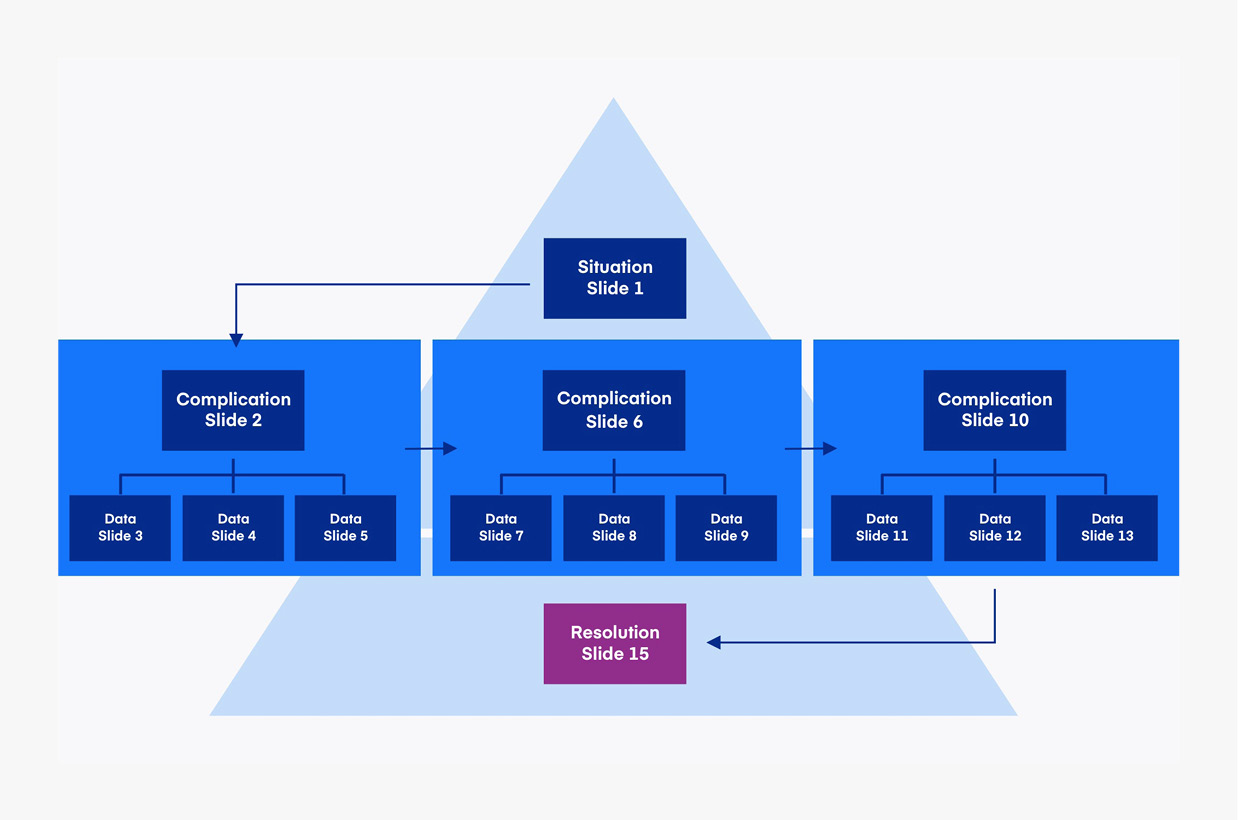
Figure 5-2: Structure your presentation with the SCR format by Ryan Rumsey
Pro tip
When creating a presentation using SCR, fill out the header of each slide first. Each header should represent a situation, a complication, a supporting argument for a complication, or the resolution. This provides the story with a clear structure before you find the appropriate data to support each slide.
As you become familiar with the approach, you’ll find it’s applicable for more than just product or design decisions. Here’s an example from my past, where I used the SCR Framework to present my decision to change the priorities of my team. I modified the structure to include three situations, three complications, and one resolution: S-C-C-C-R.
- Situation: Cultural transformation is needed to drive improved decision-making across empowered product teams.
- Complication #1: The definition of design is based on the previous business strategy.
- Complication #2: An alternate Product Management process is not a top priority.
- Complication #3: Headcount has been significantly reduced with no plans to backfill at this time.
- Resolution: Shift the focus of the design team to build future business models while collaborating on existing products in a support role.
This example allowed me to present my argument as an analytical story and resulted in a quick, “sounds good, thanks for the update” response from my boss.
While many problems can be presented with this basic SCR format, there are situations when stakeholders may disagree, have a bias towards a specific solution, or simply want to have a say in the resolution itself. By introducing alternative scenarios as resolutions, you can adjust the story accordingly. In the next section, I’ll show you how to do that.
Identify scenarios with SWOT and SOAR
When organizational trust is high, the traditional SCR format works pretty well. Your audience will generally accept your resolution and the format helps build conviction around it. In circumstances where organizational trust is still an issue, a hybrid approach to SCR often works better.
The hybrid approach I recommend incorporates two analytical frameworks used to present multiple scenarios as possible resolutions. SWOT and SOAR are good for highlighting the opportunities and risks of potential solutions, which increases the level of confidence to prioritize next steps. These acronyms may be familiar to you, but as a reminder, here’s what each stands for.
**SWOT** - An analysis used to identify the key internal and external factors important to achieving an objective. SWOT stands for: Strengths, Weaknesses, Opportunities, and Threats. Visualized with a 2x2 grid (see figure 5-3) the analysis focuses on the internal strengths and weakness of an organization and the external opportunities and threats presented to an organization. SWOT is a well-known structure commonly used inside large corporate environments.
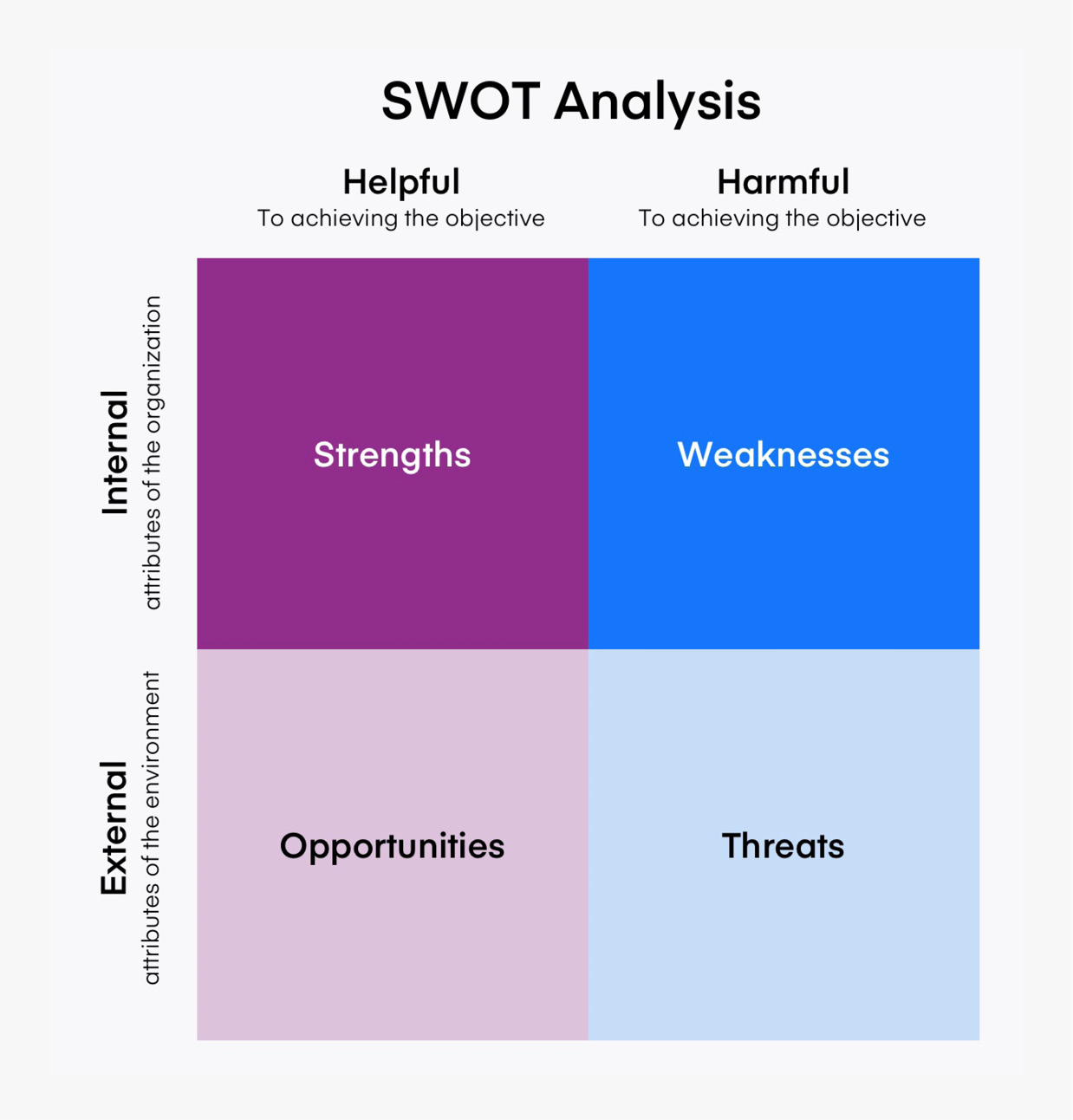
Figure 5-3: SWOT Analysis 2x2 grid
**SOAR** - A stronger option for smaller, less-developed organizations, SOAR stands for Strengths, Opportunities, Aspirations, and Results. The main difference between SOAR and SWOT is a primary focus on the positive end of the spectrum. SOAR (see Figure 5-4) analysis covers the asserted strengths and opportunities of the current state of an organization, as well as the future aspirations and results that drive organizational action.
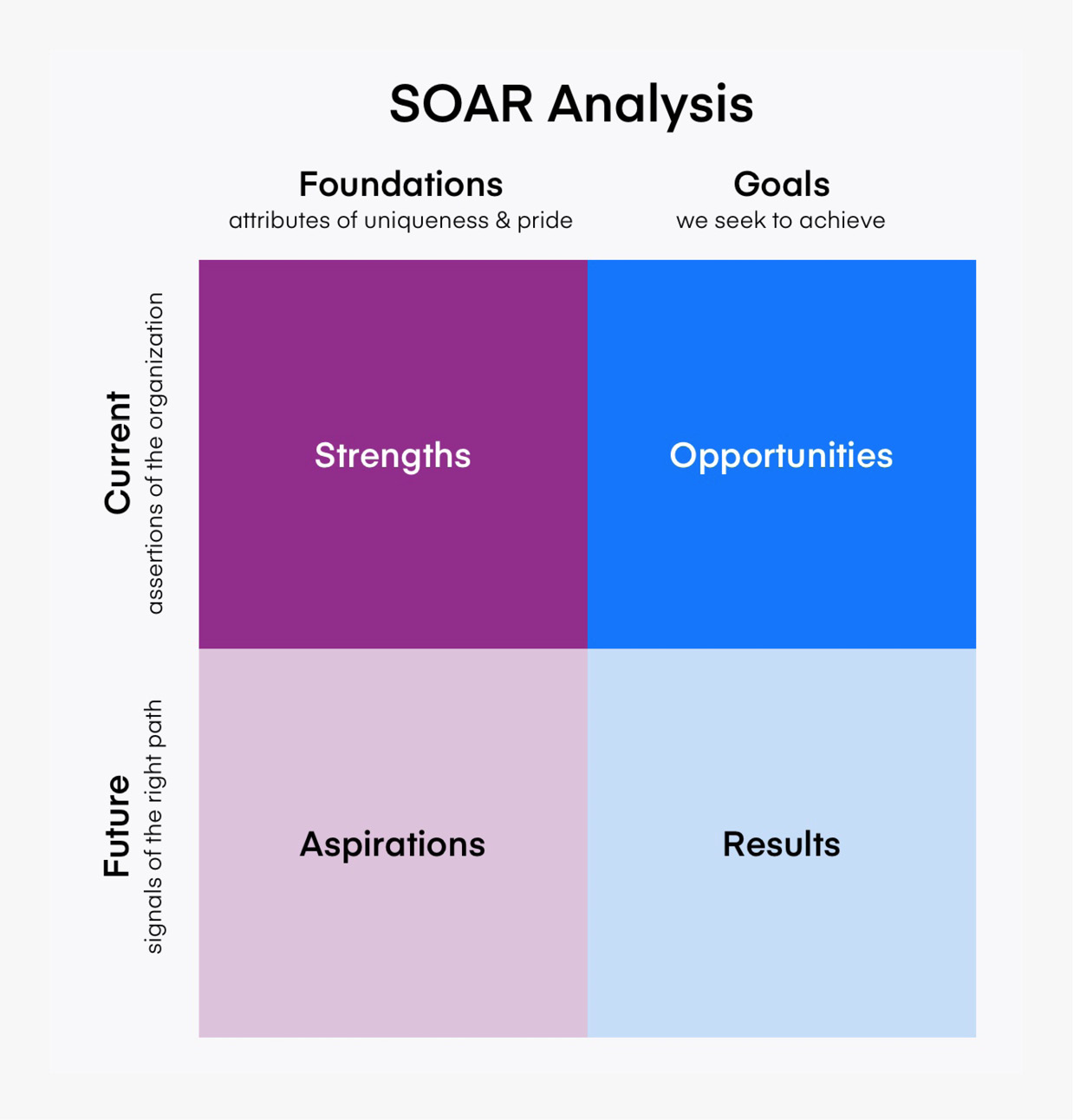
Figure 5-4: SOAR Analysis 2x2 grid
By incorporating SWOT or SOAR analysis into your analytical storytelling, the pyramidal shape continues to support the narrative as new types of resolutions are presented. In figure 5-5, the only elements that change are the resolutions. Rather than one answer, scenarios allow you to present multiple options moving forward. I’ve found this structure incredibly helpful to getting alignment quickly when multiple stakeholders are involved in a decision.
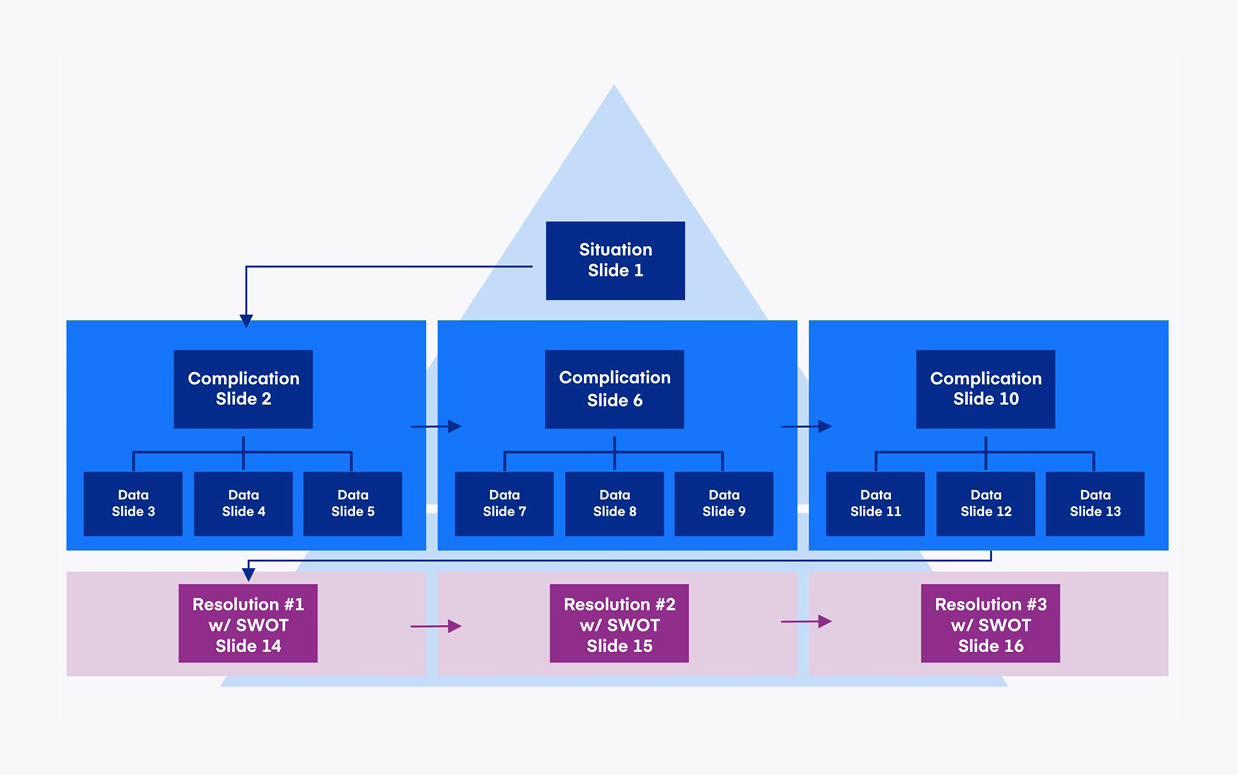
Figure 5-54: The SCR slide structure with SWOT analysis resolutions by Ryan Rumsey
Trust is the all important factor to gauge whether or not you should include scenario analysis in your story. This is where lessons from Chapter 3 and 4 come in handy. When you’ve matured your understanding of your business and your business partners, these simple tips can help you determine the ideal structure: If you’re working with partners who trust you, use the SCR structure.
If you’re working with partners who want to be heavily involved in the decision, include SWOT or SOAR analysis as part of the resolution step. Present multiple alternatives which show the pros and cons of each, while ensuring that you highlight your recommendation.
If you’re working with a devil’s advocate, start with SCR. But when they chime in, be ready with SWOT or SOAR scenarios: “I’m glad you mentioned that Todd. We looked into that and here are the scenarios we worked through. If you have any additional information that would be helpful, we’d be happy if you could share.”
Pro tip
SWOT and SOAR analysis are two of the most effective ways to communicate experimentation results. In the real world, there are multiple paths teams can take to achieve a goal. Using either of these frameworks helps leadership teams feel more confident in making a decision moving forward.
Every decision has opportunities and risks. Scenario analysis communicates where you believe risks should be taken and what rewards are worth it. To align on scenarios you can live with, it’s imperative that you present arguments effectively. Using these frameworks, you’ll not only track decisions made, but be able to track the rationale behind those decisions.
Even when you have the supporting data and make a strong presentation, there will be times when things don't go the way you want them to. This is when understanding the ambitions of your colleagues is important. It's also helpful to plan ahead for how you will negotiate if discussions get intense. That’s coming up next.
Gauge ambition and plan for negotiations ahead of time
There's a strange dance that sometimes takes place among decision-makers. Unspoken agreements are made, unexpected outcomes are presented as new ideas, and designers are often pushed to the sidelines while fates are decided. I call this the negotiation zone, and we need to be prepared to assert ourselves.
Let’s face it, the majority of design decisions involve negotiations. From my experience, the majority of trade-off decisions also come after a negotiation and to become a successful negotiator, you need to focus on three things:
- Empathize with your partners to understand their mindsets, motivations, fears, and goals.
- Do your best to remain objective. Use objectives, measures, and experimentation to support your position, rather than your emotions.
- Prepare, prepare, prepare. Studies have shown successful negotiation is 80 percent preparation.
We’ve already covered #1 and #2 in this book. To prepare for a negotiation though, you have to consider what you’re negotiating, where you’ll hold your line, and what you’re willing to give up. The Negotiation Canvas is a great tool to help.
The Negotiation Canvas
Developed by Pablo Restrepo and Stephanie Wolcott of Negotiation by Design, the Negotiation Canvas uses the familiar constructs of other canvas tools in the designer’s toolkit. Using the Negotiation Canvas, you can better prepare for your next negotiation with a partner, client, or stakeholder.
The canvas itself focuses on two separate positions: yours and that of the person with whom you’re negotiating. Within the structure, designers can prepare for negotiations by capturing desired outcomes, bargaining chips, and walk-away alternatives.
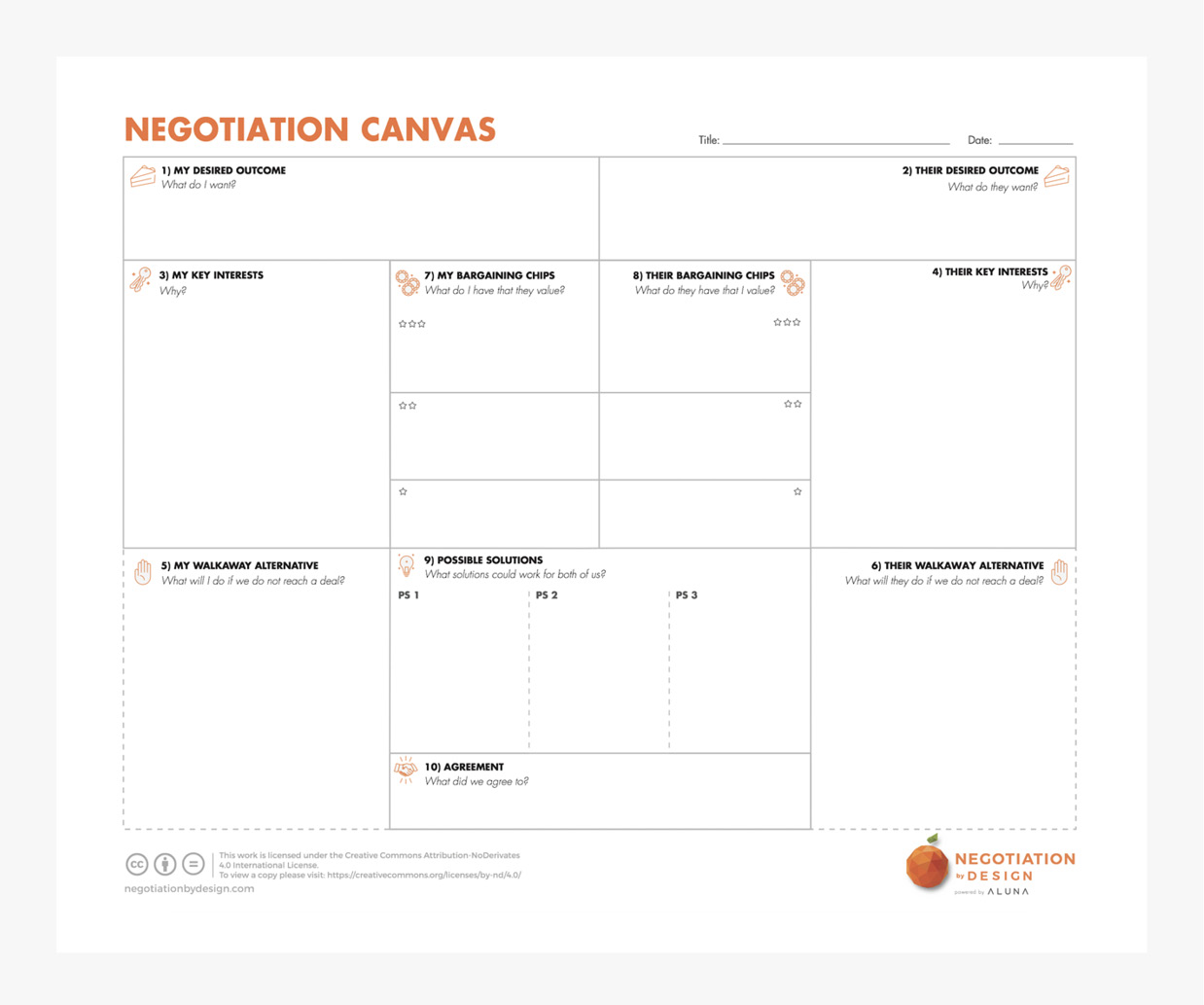
Figure 5-65: The Negotiation Canvas from Negotiation by Design
Perhaps the most valuable aspect of the canvas framework is that it forces designers to consider the point-of-view of the person with whom they’re negotiating.
Pro tip
Be the first to act in a negotiation. By setting the bar up front, you can gain a psychological competitive advantage. Referred to as anchoring, being the first to act can establish a cognitive bias when an individual depends too heavily on the initial offer (considered to be the “anchor”) while making a decision. Being first won’t work every time, but the science is on your side.
The Innovation Ambition Matrix
While preparing for a negotiation is crucial, in my experience, many occur because stakeholders or team members are not aligned on how ambitious each wants to be with a project or plan. To best gauge this ambition, there’s a fantastic tool called the Innovation Ambition Matrix.
Introduced by Bansi Nagji and Geoff Tuff at the Monitor Group, this tool is primarily used to unify and balance the innovation efforts inside an organization — but I’ve found it to be very helpful for products as well. It helps clarify where cross-functional partners “think” the organization is playing and how everyone expects the organization will win.
The matrix itself is based on a graph with “How to Win” on the x-axis and “Where to Play” on the y-axis. From a product standpoint, “How to Win” can be any of three types of products in an organizational portfolio: existing, adding incremental features, or developing something new (radical). “Where to Play” points to the types of customers the product will serve: existing, adjacent, or a new customer market.
With this graph set up, the primary goal of the Matrix is to determine how ambitious cross-functional partners want to be. There are three levels of ambition:
- Core: Optimize current offerings
- Adjacent: Add new features
- Transformational: Create new products
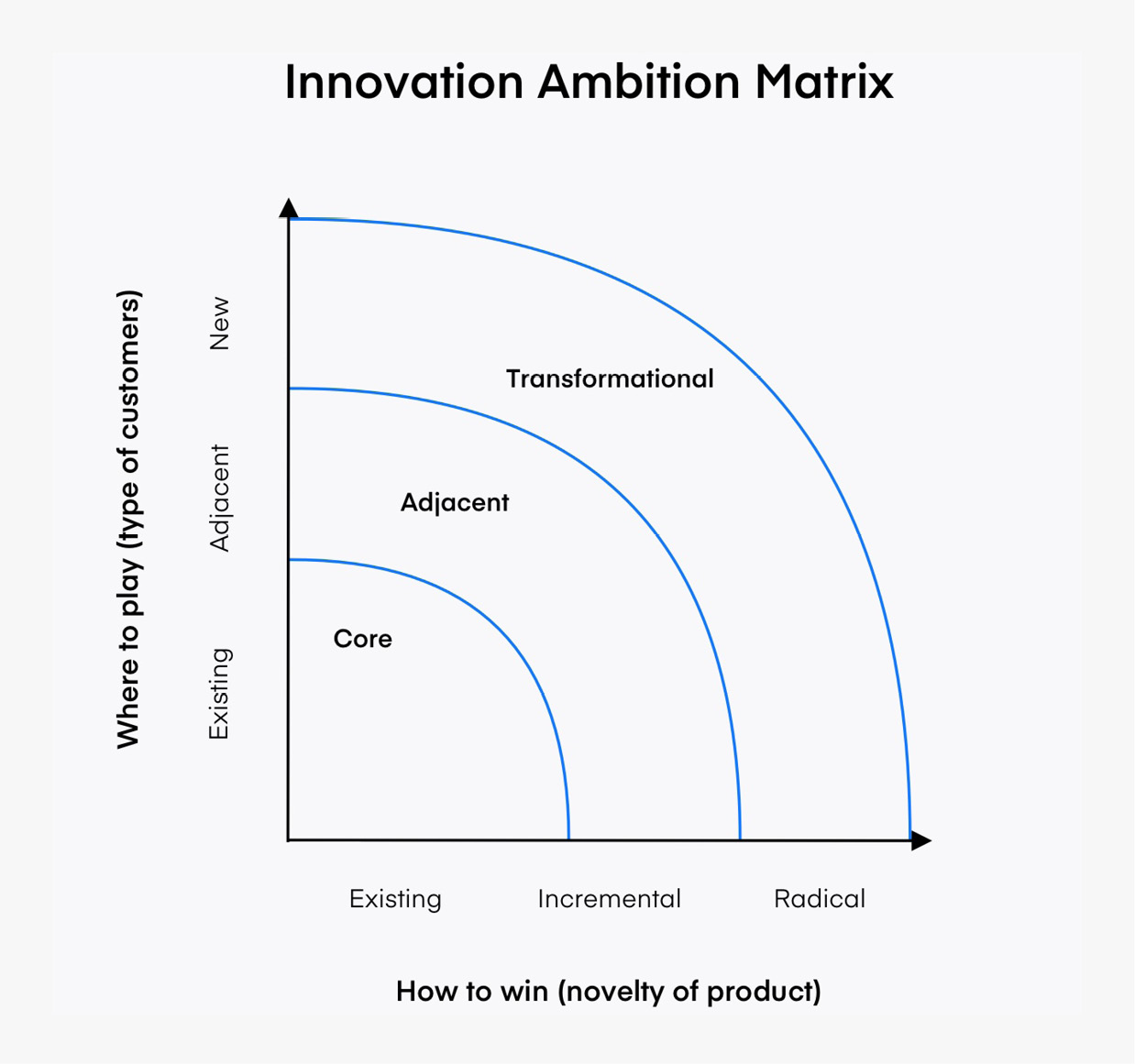
Figure 5-7: The Innovation Ambition Matrix from Monitor Group
The best times to measure ambition are at the beginning of a project or when workshopping new ideas. In either scenario, I take the following steps to complete the activity:
- Draw the grid.
- Assign Post-it colors to cross-functional partners.
- Ask each partner to capture the projects or features in the backlog on Post-its.
- Place Post-its on the grid according to how ambitious they believe the team should be with each.
- Analyze any deltas that show up on the matrix and use those to find an agreed level of ambition moving forward.
Pro tip
The Innovation Ambition Matrix is a fantastic activity for getting alignment and buy-in with a design system. Since a design system can range in complexity, getting clarity on ambition proves a valuable exercise before committing resources to creating or updating it.
This Innovation Ambition Matrix is so simple, yet so helpful to getting partner alignment up front. When approached as a cross-functional team activity, a completed matrix is a wonderful way to negotiate before the stakes are too high and emotions get involved. It’s the perfect tool to share with your industry friends.
Conclusion
Communicating well is a key for influencing business decisions and outcomes. By adjusting your communications, designers can show their business partners that they’re capable of working in multiple ways, as well as prepare for any difficult decisions.
In the final chapter, we’ll take the lessons learned thus far and show how you can put them all together. The goal is to help you mature your approach, which in turn will help mature design in your organization.
Further reading
- 5 steps to find stakeholders and key collaborators who will champion your ideas.
- The rule of three by Brian Clark, Copyblogger founder and host of Unemployable
- How to Tell a Business Story Using the McKinsey Situation-Complication-Resolution (SCR) Framework by Jeremey Donovan, SVP of Research & Advisory Services at CB Insights
- The Pyramid Principle by Ameet Ranadive, Chief Product Officer at GetYourGuide
- The Negotiation Canvas download from Negotiation by Design

Chapter 6
Put it all together
How effective communication helps business partners understand design
Regardless of the design role you’re in now or what your next role might be, the lessons in this book are intended to be universal. While you’ll be faced with different business challenges at every company you work for, the basics remain the same.
So let’s talk about how you can apply them in your current role and organization. Whether using SWOT or SCR, Strategy Maps, or the Negotiation Canvas, these methods and practices are all rooted in the same basic outcome: increasing the business impact of design.
This chapter will share effective ways that you can begin incorporating these lessons inside your organization:
- Integrate with familiar methods and practices
- Introduce a rating scale and scorecard
- Cultivate your consulting skills
- Target appropriate levels of design maturity
Integrate with familiar methods and practices
In social psychology, there’s an effect called the **familiarity principle**. Basically, it means that people prefer things they’re familiar with over things they’re not.
As a designer, when you introduce a new workshop, research finding, or design, keep this principle in mind. Because your colleagues will be more open to what you share if they’re able to associate it with something they already know.
A smart way of increasing your influence is to incorporate your information into existing processes, meetings, rituals, or presentations. If you do this, your collaborators will feel more comfortable, and they’ll be more likely to sort and classify the information you present in a useful way.
During my time at Electronic Arts, my team worked closely with the IT organization. Our colleagues in IT were very familiar with the phase-gate process (waterfall) of project management. To help transition the team into modern, agile product management processes, we re-used the word phase-gate to introduce new ways of working. For example, “Here are the phase-gates for launching digital products.”
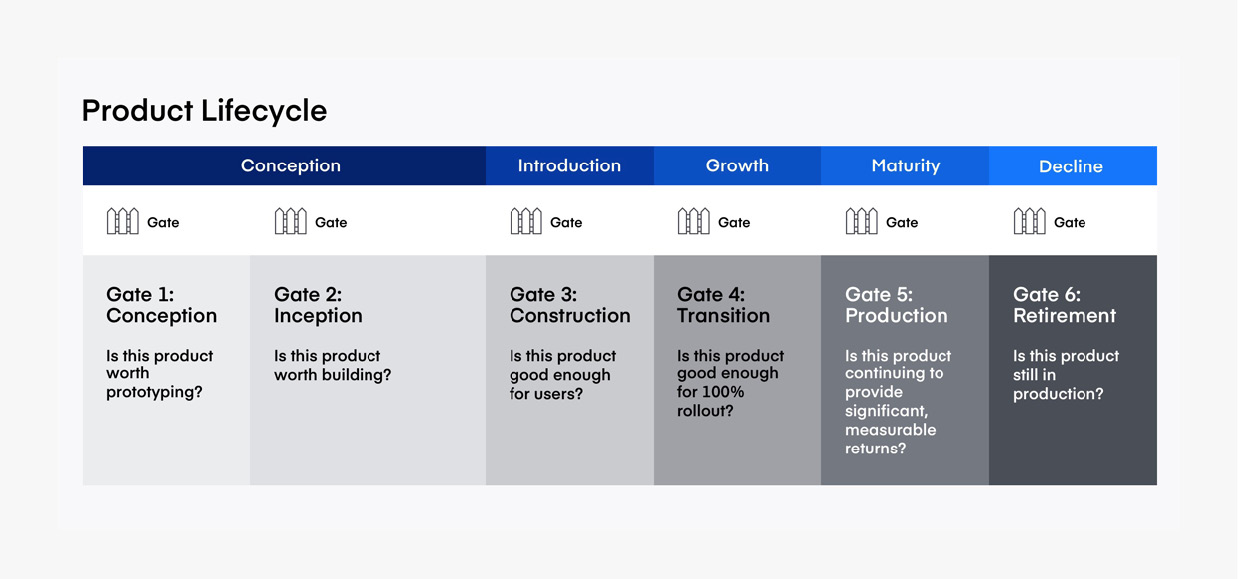
Figure 6-1: Product Management phase-gates by Ryan Rumsey
Reusing familiar language helped my colleagues understand that decisions had to be made in phases (something also familiar to them) while allowing us to introduce the phases of a product life cycle and the different types of decisions we needed to make (something new).
Pro tip
Integrating these lessons is not foolproof. Like any method or process, they may not work exactly as directed. What level 4 and 5 teams do better than most is test and apply new approaches again and again to learn what works and what doesn’t. Treat these lessons as features to test with your colleagues.
As mentioned in Chapter 1, there’s no linear process for applying the lessons in this book, but my advice is to start with empathy, then visualize the business model and strategy. By doing so, you can quickly assess what is familiar to your colleagues before breaking new ground.
Rather than reinvent the wheel, here are some scenarios for how you can incorporate the lessons into familiar methods and practices.
**Scenario:** Your collaborators don’t understand how new features or designs will impact the current business model.
**Solution:** Add EcoSystem Map and BMI triangle activities to Design Sprints or backlog grooming activities. This will ensure that your team understands the impact new features will have on the business model.
**Scenario:** You’ve struggled to get buy-in for research, recommendations, or new design activities.
**Solution:** Reverse-engineer presentation decks that have been successful with your stakeholders. Rather than create a presentation on your own, ask your business partners if they can share decks they’ve used in the past to get funding, approvals, or decisions. Modify those with analytical storytelling structures like SCR or SWOT and your stakeholders will better understand your reasoning.
**Scenario:** You’ve just been re-organized and now report in to a new executive leader, a new team, or a new line of business.
**Solution:** Developing empathy is one of the quickest ways to understand what your new colleagues do, what problems they’re trying to solve, and what they’ve had difficulties with. Use Empathy Maps after any organizational changes to help you identify how you might be helpful and demonstrate your interest in learning.
As you incorporate the lessons from this book into the existing methods and practices at your organization, you’ll naturally begin to understand the benefits of how your business partners work, despite initial aversions you might have to their processes.
Develop ratings, rubrics, and scorecards
Journey Maps and Service Blueprints are examples of powerful visualization tools that designers have at their disposal. Both communicate comprehensive and detailed analyses of the interactions customers have with companies and the processes organizations use to deliver those interactions. And yet, I’ve seen many business partners struggle to know what to do with the information these tools provide.
In my experience, many design concepts or research insights are often appreciated, but misunderstood by technical and business partners. As a result, organizations can struggle to incorporate important context into prioritization and decision-making activities.
One of my favorite ways to provide clear, accessible context is to establish a rating scale with rubrics. If you recall from Chapter 4, desirability factors like usability or credibility influence adoption, and rating scales successfully communicate how they’re being addressed.
Rating scales and rubrics
Simply put, a rating scale is a set of categories with an associated value for a feature, a product, or an experience. Common in surveys, psychological assessments, or education, rating scales are also popular for business measurements like Net Promoter Score or Customer Satisfaction.
Rubrics, on the other hand, are the criteria used to evaluate overall performance. They consist of a rating scale and a detailed description of the characteristics for each level of performance. These descriptions focus on the quality of performance.
A common measure of usability is how well users can complete tasks. Here’s an example of a rating scale with rubrics to help determine the quality of task completion:
- Does not complete task
- Successfully completes task with a lot of support
- Successfully completes task with some support
- Successfully completes task with minimal support
- Successfully completes task as expected
An effective way to monitor and track usability or accessibility improvements over time is to present the status of these ratings through a scorecard.
What is a scorecard?
You’re probably familiar with scorecards as a concept. In the sports world, scorecards keep official records of play-by-play action with a tally of hits, catches, runs, outs, passes, fumbles, goals, etc. What you may not know is scorecards are common in the business world as well.
One of the most popular business concepts over the last 30 years has been The Balanced Scorecard. Developed in the early 1990s, The Balanced Scorecard was popularized by Robert S. Kaplan and David P. Norton in their book of the same name. The concept itself is billed as a semi-standard report that can be used to track and monitor execution activities across a variety of products or services.
Many management teams across industries use scorecards to monitor and track both financial and non-financial objectives and key results. But unlike game scorecards, organizational scorecards are not meant to actually keep score, but rather to identify gaps and deficiencies that need priority attention. If you’ve ever been in a meeting with senior leaders or executives and they’re using an excel sheet or dashboard with a bunch of red, yellow, and green, that’s a scorecard!
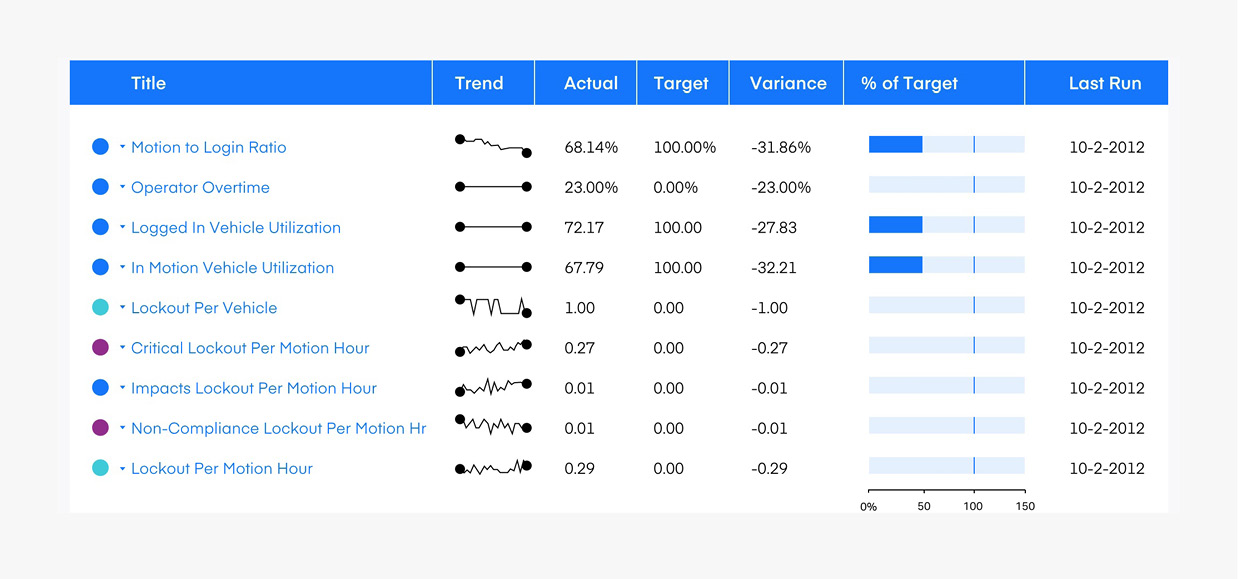
Figure 6-2: Example scorecard by Greenooo [CC BY-SA https://creativecommons.org/licenses/by-sa/3.0]
Ultimately, it’s the information inside a scorecard that’s important. And this is where you’ll embed rubrics and rating scales to regularly update your product managers, engineers, and executives.
Figure 6-3: The UX Scorecard by Atlassian is a great resource for maturing your approach to app improvements.
While ratings and rubrics really help with improving the quality of products, business leaders can struggle to connect small product improvements to the overall business. That’s because the pace of the organization is different than the pace of a product.
Improvements to products are frequently released in weekly or monthly cycles, while the strategic reviews, project funding, or financial reporting of a company is often done in quarterly, bi-annual, or annual cycles. At the product level, improvements may show up quickly through testing, but longer term effects of those improvements may take months or more to show up at the organizational or business level.
Pro tip
Scorecards take time to develop and mature. To gain buy-in for introducing them, I recommend using analytical storytelling to present the risks and opportunities of having scorecards (or not) to track improvements.
Create a design scorecard
Mature design teams don’t just experiment before going to market, they measure the effects of the designs in the market over time.
Design scorecards are effective reports for showing the impact and results of overall design work. They are also an incredibly effective way to help cross-functional partners prioritize key factors like credibility or usability, because they connect project or product level deficiencies to the portfolio level.
I first learned about scorecards while I was at Apple. My colleagues in Program Management were using Balanced Scorecard reports to communicate their progress to executive leadership. Fascinated, I did some research on the origins of the approach and began to prototype different types of reports for design activities using the same approach.
Figure 6-4: The Desirability Scorecard by Ryan Rumsey
By establishing a rating system for design efficacy across products, design teams can communicate the impact of their work at both a product and organizational level, even while using different rubrics or metrics. A standard rating communicates both a point-of-view for trade-off decisions and helps to audit the design team’s ability to expose priority areas of need.
Over the last 10 years, I’ve refined my own scorecard approach to track and monitor design OKRs, KPIs, etc. to communicate the impact of design. This approach has been the core of my work with companies and design leaders since launching Second Wave Dive in 2019.
Incorporate a consultant mindset
Are you able to let your colleagues come to their own conclusions?
Some of the most effective designers I know practice the art of letting other people have their way. They’ve learned over the years that by allowing their colleagues to put ideas or thoughts on the table, they remove any anxiety those colleagues might be having about a negotiation. Once that anxiety is removed, these designers are in a much better scenario to present alternative ideas as amendments or add-ons to the original idea rather than in opposition. Similarly, I’ve noticed over the years that great consultants (regardless of their background) are also really good at letting others come to their own conclusions.
To develop this mindset, learn how to ask open-ended questions about the current state of affairs before jumping into solution mode. Some questions I’ve used in the past:
- How does this impact the business?
- How are you measuring improvements right now?
- What are the risks of not doing anything at all?
- If you had to choose an item to work on first, what would you choose? Why?
Consultants are also strong influencers because they think like executives. Many of the lessons in the book represent ways I’ve been able to develop my ability to think like an executive, which ultimately helped me become one.
One of the most important things to remember is that executives have limited time. They’re schedules are full, days are endless, and they need help processing information quickly. Designers who can communicate concisely and effectively are more likely to get invited back to future discussions.
Pro tip
Consultants are able to highlight the risks and opportunities involved in decisions and they know that every decision has both. When you work with collaborators and leadership teams, show data and rationale to support your reasoning by consistently highlighting the risks and opportunities of a decision.
In conclusion, the consultant mindset is focused on making sense of confusing and complex situations. Ask yourself, “Am I adding to the confusion, or relieving it?” If you’re adding to the confusion, work on acting like a consultant. If you’re relieving it, you're going to be a successful design leader!
Assess and target the appropriate level of design maturity
Conclusion
My hope is that, after reviewing the lessons and tips I’ve recommended, you not only feel better equipped to work with colleagues, but you also feel some relief about your day-to-day responsibilities.
By developing a business perspective, you know how to anticipate the needs and behaviors of your colleagues. You know how to visualize your business to learn your business. You recognize that meaningful, productive, ethical, and transformative designs also need to create competitive advantages. Finally, you know how to speak in the languages that help your colleagues understand the full value of design.
While these tips provide pragmatic steps, leveling-up design maturity takes time. You’re part of a journey, and with these skills, you’ll be in a position to progressively impact your organization in exciting new ways. As you begin to use what you’ve absorbed here, you’ll not only be seen as an effective designer, but also as an effective collaborator.
Thank you for inspiring me to share what I’ve learned. I can’t wait to see what your future holds!
Further reading
- The ultimate list of Design and DesignOps metrics
- The Balanced Scorecard by Robert S. Kaplan, Harvard Business School professor of accounting
- The UX Scorecard for Apps by Lori Kaplan from Atlassian
- What Consultants Do by John Kim from Consultants Mind
Download Business Thinking for Designers as a pdf
Appendix I
Bonus Articles
Additional resources to become a business savvy and street smart designer
Now that you've become good at business, here's a bunch more writing I've done over the years to continue raising your influence, and position design to win.
Get good at leading design orgs…
- [The CDO School Design Leadership Playbook](https://thecdo.school/articles/the-cdo-school-leadership-playbook/)
- [You're now in charge. What's the plan?](https://thecdo.school/articles/youre-now-in-charge-whats-the-plan/)
- [5 things Design VPs are paid to do differently than a Director or Manager](https://thecdo.school/articles/5-things-design-vps-are-paid-to-do-differently-than-a-director-or-manager/)
Get good at strategy…
- [Four Fits to make Design crucial at your company](https://thecdo.school/articles/four-fits-to-make-design-crucial-at-your-company/)
- [Four Fits: Finding Business Model - Design practice fit](https://thecdo.school/articles/finding-business-model-design-practice-fit/)
- [Four Fits: Finding Design Practice - Partnerships Fit](https://thecdo.school/articles/finding-design-practice-partnerships-fit/)
- [Four Fits: Finding Partnership - Positioning Fit ](https://thecdo.school/articles/finding-partnership-positioning-fit/)
- [Track and adapt how design creates, delivers, and captures for the rest of the company](https://thecdo.school/articles/track-how-design-creates-delivers-and-captures-for-the-rest-of-the-company/)
- [Quickly evaluate if the conditions are ripe for change with Force Field Analysis](https://thecdo.school/articles/quickly-evaluate-if-the-conditions-are-ripe-for-change-with-force-field-analysis/)
- [Selling a Design System before asking for buy-in](https://thecdo.school/articles/selling-a-design-system-before-asking-for-buy-in/)
Get good at communicating effectively…
- [Create strong business cases with The Situation, Complication, Resolution (SCR) framework](https://thecdo.school/articles/create-stronger-business-cases-with-the-situation-complication-resolution-scr-framework/)
- [SWOT and SOAR; your stakeholders' favorite way to evaluate risk](https://thecdo.school/articles/swot-and-soar-your-stakeholders-favorite-way-to-evaluate-risk/)
- [Effectively communicate the value of Design with a scorecard - what I learned at Apple](https://thecdo.school/articles/effectively-communicate-the-value-of-design-with-a-scorecard-what-i-learned-at-apple/)
Get good at politics…
- [5 steps to find stakeholders and key collaborators who will champion your ideas](https://thecdo.school/articles/5-steps-to-find-stakeholders-and-key-collaborators-who-will-champion-your-ideas/)
- [Active listening is a powerful way to grow your influence–and it's learnable](https://thecdo.school/articles/active-listening-is-learnable/)
- [The Importance of Mapping Power Dynamics](https://thecdo.school/articles/mapping-power-dynamics/)
Get good at ROI stuff…
- [The ultimate list of Design and DesignOps metrics](https://thecdo.school/articles/our-ultimate-list-of-metrics-for-design-leaders/)
- [The Best Way to See How Everyday Design Work Connects to Business is to Make a Map](https://thecdo.school/articles/the-best-way-to-see-how-everyday-design-work-connects-to-business-is-to-make-a-map/)
- [Measuring Design is an act of bravery](https://thecdo.school/articles/measuring-is-an-act-of-bravery/)
- [Four categories of product quality (desirability) health](https://thecdo.school/articles/the-four-categories-of-product-quality-and-design-health/)
- [Pragmatic lessons to measure design and track metrics](https://thecdo.school/articles/pragmatic-lessons-to-measure-design-and-track-metrics/)
- [Why Designers might actually like data: A case for gaining statistical literacy (video)](https://thecdo.school/articles/a-case-for-gaining-statistical-literacy/)
Appendix II
Bite-Sized Videos
Quick, pragmatic lessons to see business stuff in new ways
**OKRs for Design Orgs**
**Data and Statistics for Designers**
**Get Good at Winning Allies**
**Understanding North Star Metrics**
**Demystifying ROI**
**You're Being Strategic When…**
Appendix III
Book Reviews
A handful of the reviews and messages I've received over the years
Today (April 10, 2025) is a special day. Business Thinking for Designers turns 5.
It was released 3 weeks into the global pandemic, without much fanfare or celebration.
My wife and I were knee deep in trying to figure things out how our family would survive, how we'd be able to give our kids a sense of fun and curiosity when everything around them was scary, and how we'd maintain any capacity for our own energy so that we could be present for our kids.
I was six months into my entrepreneurial adventure. I had no idea what I was doing, was worried constantly how I'd be able to make enough money to pay for the basics, and saw all the momentum I had been building quickly fade away.
Meanwhile, this little book was released to the world.
For five minutes, I forced myself to dance to The Weeknd in my living room. Hoping that in some way I'd feel some type of comfort or happiness for having worked so hard to get to that day.
But honestly, I felt empty.
That is until [Danielle Torrico](https://www.linkedin.com/feed/#) gave the book a ⭐ ⭐ ⭐ ⭐ ⭐ on [goodreads](https://www.goodreads.com/book/show/53251578-business-thinking-for-designers).
I had never anticipated that strangers would read the book and share their feedback.
All those feelings I was waiting for – joy, accomplishment, and a sense of connection, they came when people began thanking me. They shared with me their experiences and what the book meant to them. I was overwhelmed that a thing I wrote played a positive role in their lives too.
While I was excited about publishing this book, I had not even considered that people would respond and give feedback. The emotional impact that these reviews have had on me has been humbling to say the least. I'm am so grateful that this book has played enough of a role that people felt compelled to share a review, or message me personally about how much they enjoyed it.
Here's a sample of the feedback I've received over the years. If anything, I hope reading these encourages you to consider writing and sharing it with others.
> Your book has been eye-opening for me as a new-grad designer. I absolutely loved it. THANK YOU! — Suyash Thakare
> I have been thinking of starting something of my own for a while and this global pandemic has given me time to do so but I don't know how so I started doing a research online and I stumbled upon your book business thinking for designers and it has been very insightful. — Tolulope Nejo
> First of all - I really need to say I’m loving your perspective about business and designers. For a long time now I’m trying to talk about this, but it seems like a taboo in the design community and it’s a delight to find an alike mind in this perspective. So I’m deep diving into all your lectures, podcasts and your book. — Carolina Tod
> As the "UX team of one" person at my workplace, this is gold. — Bruno Lucena
> I just sat down yesterday and read your latest book - "Business thinking for designers" and I just wanted to reach out and say this was the exact book I needed to read. Understanding the business side of things and being about to work with business thinking in mind is key. I've actually written this down as a goal for this year as a key area of learning for myself. — Nick Blanche
> I just wanted to reiterate my appreciation for the book – as I said, I'm an early stage designer, but it's such an amazing resource to get a jumpstart on what it's like to empathize and communicate with non-designers! — Evan Linsey
> It just hit every nerve and there was so much I could take home from it, thanks a lot for sharing your insights and thoughts. I really liked that you brought up the fact that actually listening to your colleagues' needs and approaching them like you would in a kickoff of a new design project really resonated with me. I have a background in psychology so I do look out for these type of things as they are very important to me. It's great to hear that there are people trying to change the way we interact with other departments and break the barriers down, one step at a time. Stepping into my colleagues' shoes is something I'll try to do more from now on. I also listened to your (audio)book during my workdays and it was very inspiring. I actually discussed your webinar with a software developer and he was very excited about it immediately. So I think the thoughts and ideas you put out are not at all limited to designers but also resonate with devs, for example. That's really cool. — Stefanie Scheid
> Thank you Ryan for making “Business Thinking for Designers” available for free and shedding light on a subject that is too often neglected by design programs, but of tremendous value. — Phoebe Goldenberg
> It’s jam-packed full of tips, models, strategies, and additional resources that any designer looking to move beyond pixel pushing should understand. Well done Mr. Rumsey and InVision! — Russell
> If you need a short and solid primer to start with, get Business Thinking for Designers, by Ryan Rumsey. It's solid, concise and practical - focused on tasks, frameworks and how to be confident/effective. — Scott Berkun, author of How Design Makes The World
> Designers need to know how to communicate their business value. The importance of this point hasn't changed, but the urgency has. Designers must learn how their business works and how to speak the language, right now as the economy and customer needs are reforming in realtime. Check out the brand new book, Business Thinking for Designers, a fantastic resource to address this problem. —Adam Fry-Pierce
> Definitely useful handbook for the designers who find the interest in design performance evaluation and showing design's value in creating competitive advantage. I am extremely grateful for this precious resource, it saved my time, opened my eyes and raised my interest towards these subjects. — GIGLEMIANI Nana
> Business Thinking for Designers is brilliant! — Rob Goodman
> I learned lots of new stuff from this book and I love how it shows how some famous frameworks could be applicable in this context; negotiation canvas, pyramid principle, you name it. — Ivana Putri
> Excellent book! Highly recommended. I was so impressed that I even enrolled the six weeks course organized by the author. — Charles-Henri Lison
> Ryan Rumsey's course changed my perspective as a designer. Now it's all in a book! Learn practical strategies, vocab, tools, tips, frameworks in his new book "Business Thinking for Designers." Thanks for sharing, & my 1st book acknowledgment. — Nguyet V
> Whenever I dip back into Business Thinking for Designers, I keep bumping into lovely little ways to improve my communication skills. The S+C+C+C+R framework is very useful for slides and presentations. — Richard Banfield, co-author of Product Leadership: How Top Product Managers Launch Awesome Products and Build Successful Teams
> Lots of good visuals, tools, and definitions. These same qualities make it difficult to parse from an audiobook, so read the ebook version (also free). As he says in the introduction, this is a reference book, and I can see it coming in handy throughout the work week. — Grant Baker
> If you haven’t already, go read Business Thinking for Designers. I have learned so much already. — Jakoby Jonsson
> Excellent and easy to understand. Must read! Coming from business background, I still learned something new from this book. Best, it’s so much easy and interest to read (listen as I got the audio version) than all the other business textbooks. I felt energised and enlightening after each chapter:) — Lp Lin
> It has been a revelation and has hugely impacted my thinking about communicating the value of design to business partners. It’s very generous of you to make this information available freely. Thank you for all you do for the design community.”Geo George“Amazing! Thank you for your contributions to our field! This was amazingly useful for me as a "Business Thinker" learning and leaning more into design (I work in design operations now). — Chris Denhart
> The book is incredible and a must-read for Design leaders. I am halfway through the book and every page of the book adds value to my design career. I wanted to say thank you for putting out such an amazing book. — Hiten Rajgor
> I wanted to thank you for all your thoughtful, inspired and inspiring writing. You have really helped me to rethink design from a deeper perspective. — Alan Ruthazer
> Thank you for writing such an amazing book and sharing the knowledge to the design community. I work in a growing startup and doing dual role as both a business analyst and a product designer. Your book was such a perfect book to me and got to know many things that I need exactly at this stage. Being not an expert, I even managed to handle a new client call really well yesterday by just reflecting on the knowledge on business I got from your book.I am grateful and thank you for making an impact and increasing my confidence what I do :) I have started experimenting the business thinking ideas and started learning on my own! I will always refer to your book whenever needed. — Mahasri Jayan
> Your book helped me gained confidence by showing me that understanding the business and the objectives of business facilitates the communication with stakeholders and other cross discipline professionals. This fundamental truth reinforces that I have to speak their language and display how the UX process is aligned with their goals of the business. — Carl
> Just to say I really enjoyed your book on Business Thinking for Designers. Not only did most of the content resonate, I also learned quite a few things! — Jennie So
> I recently came across your business thinking for designers book with invision and it’s been a huge help as I transition into my new role! — Roberta Dombrowski
> Business thinking for designers is such an awesome book! As a designer who is passionate about the intersection between design and business, I enjoyed every page of your book Ryan! Thank you! — Biniam Kebede
> I read your book, Business Thinking for Designers and found it immensely valuable. Just wanted to share my sincere compliments. — Raunaq Shah